BUDAPEST -- After a week aboard the Viking Gullveig on the Danube and eating our way through German and Austrian Christmas markets, we had arrived in the Paris of the East: Budapest.
Here, I broke off from the near-daily Christmas market excursion to instead embark on a full-day shore excursion with Kensington, a luxury tour operator that has reported a substantial spike in its shore tours.
After connecting with the operator's cruise expert, Susan Mercurio, I shared my requests: I'd like to learn about the history of the city, enjoy some local cuisine and end my day at the famous baths.
Soon after that initial phone call, Mercurio whipped together an agenda, one that included my wish list and accounted for my tight schedule; the ship was scheduled to arrive in Budapest by 9 a.m., but that timing could shift due to river traffic, and I wanted to be back early enough for our final dinner, which I could only guesstimate since I didn't yet have my schedule.
I had been looking forward to the experience all week, eager to visit Budapest for the second time. I had been to Hungary's capital in March and left slightly disappointed, feeling as if I was unable to fully enjoy the city due to a near-constant drizzle of rain and cold temperatures.
My driver, Attila, and my personal guide, Sandor, met me in front of my ship on the Pest side of the city a few minutes before 10 a.m. Then we embarked on a walking tour along the Danube. Sandor, who has worked as a guide since 1991, spoke at length about the history of Budapest and Hungary, while pointing out sites of interest: Buda Castle, the Szechenyi Chain Bridge, the Shoes on the Danube Bank memorial.
He explained the city's modern history, including the extensive damage the city endured during World War II -- 80% of the city was damaged, left in ruins -- and the Soviet invasion of Hungary and the decades that followed living under communist rule until 1989, when the Eastern Bloc dissolved.
Sandor spoke of travel, which under Soviet rule was only possible for Hungarians under very strict conditions, and how he read travel magazines and brochures as a child before finding himself in tourism as a career. Now, he's a licensed guide for Budapest and Jewish heritage tours. The tour was guided by our conversation, and while Sandor interjected to point out landmarks or important locations, he tailored his comments and tour topic to our discussion, making it feel natural rather than something he had performed countless times.
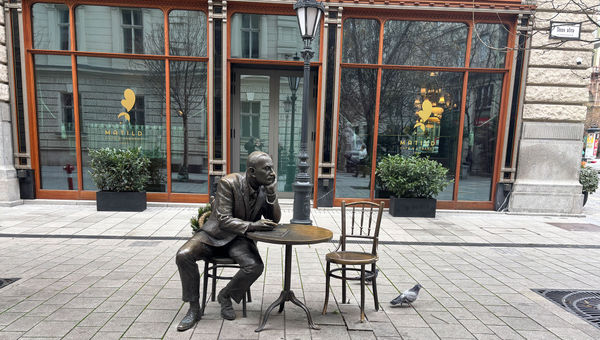
A statue located near cafes in Budapest signals the importance of historic coffeehouse culture for the city's intellectuals and literary community. Photo Credit: Brinley Hineman
We walked through the city toward the Central Grand Cafe & Bar, where a traditional Hungarian breakfast was waiting at one of the city's most famous coffeehouses. Like in Vienna's famous cafes, this historic 1887 eatery once served as a bastion for Hungarian intellectuals, particularly as a vibrant literary center. As I noshed, a violinist serenaded patrons.
From there, I ended my day at Szechenyi Baths, where I spent the afternoon baking in the sauna and bouncing from pool to pool -- even plucking up the courage for a quick plunge in the cold pool despite the December chill. Floating in the great outdoor pool at the center of the bathhouse's courtyard, heated by natural hot springs that emitted hazy clouds of steam into the air, I realized I didn't mind Budapest in cold weather after all.