With the holiday rush building up on Dec. 23, ski areas across Colorado struggled to open even 20% of their terrain because of historically low snowpack.
But Monarch Mountain, located along the Continental Divide in the center of the state, had 51 of 77 runs open.
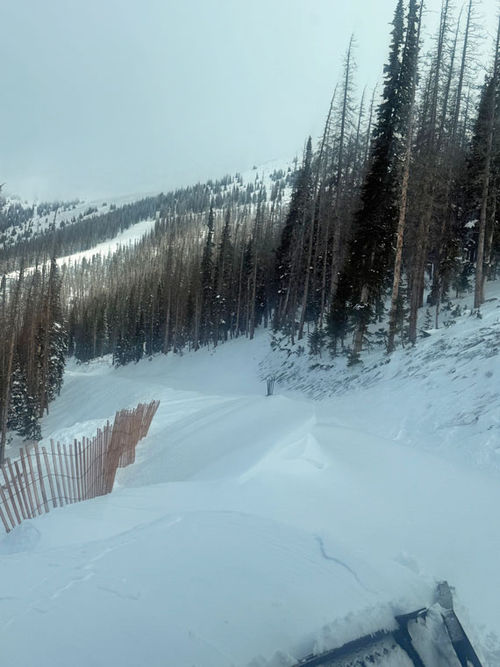
A temporary wind fence at Monarch Mountain has accumulated snow. Photo Credit: Monarch Mountain
Monarch's secret? It wasn't a heavier helping from Mother Nature. And it wasn't better snowmaking facilities. The independently operated ski area doesn't even make snow.
Instead, Monarch relies extensively on what's known as snow farming, which involves trapping wind-blown snow with a network of strategically placed fences, and then using snowcat grooming plows to spread the resulting snow piles across the slopes. The mountain also catches snow with what Monarch CEO Chris Haggerty called "wind rows," which are akin to raised curbs, except built out of snow.
"We've gotten really good at knowing, based on the wind direction and weather, what parts of the mountain are going to load up," Haggerty said.
Throughout the ski industry, measures to provide more reliable snowpack, especially during the early season, are growing in importance as climate change makes snowfall less predictable. According to Bank of America Global Research, average annual snowfall in the U.S. declined by 11 to 17 inches from 1994 to 2024, with larger declines in the West.
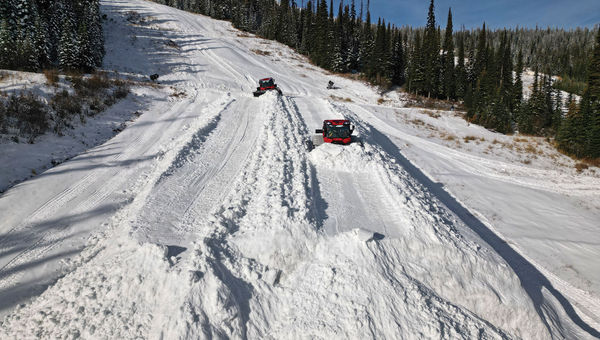
Sun Peaks snowcats spreading the snow it stored over the summer to secure an early November opening. Photo Credit: Sun Peaks
Snowmaking, of course, is the primary resiliency strategy for ski resorts far and wide. Industry giant Vail Resorts, for example, has made more than $100 million in snowmaking investments since 2015.
Still, as of 2023, just 17% of skiable acres in the U.S. were covered by snowmaking, according to the National Ski Areas Association. In the Mountain West, which includes Utah and Colorado, just 11% of ski terrain is fed by manmade snowmaking, according to BofA Global Research.
Building out more snowmaking is costly. And operating the equipment is both energy- and water-intensive, although much of the water used returns to the watershed once the snow melts.
So, Monarch and other ski resorts are looking to alternative methods to bolster their snow during early season lean times.
Snow farming is done at many ski resorts. Monarch, though, places a particularly sharp emphasis on it, due in part to its wind-advantaged location along the Continental Divide and to its absence of snowmaking. During this season's record-warm November, Haggerty said, the resort doubled its movable fences, purchasing 30 additional 50-foot sections.
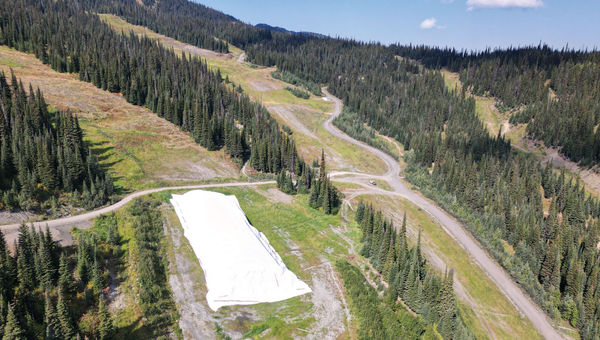
Approximately 15,000 cubic meters of snow was stored last summer at Sun Peaks, protected from the sun by a reflecting and insulating cover. Photo Credit: Sun Peaks
Another solution: Snow storage
Some ski areas have also turned to a more novel solution. The sustainable snow storage system of Finland-based Snow Secure debuted in the company's home country a decade ago. This season, it made entry into North American alpine skiing at Sun Peaks in British Columbia, Bogus Basin in Idaho and Tyrol Basin in Wisconsin.
The Snow Secure system enables ski areas to pile and preserve large volumes of snow at strategic spots on the mountain during the off-season for reliable deployment in the fall. It does that by insulating the snow and deflecting sunlight with a white polystyrene (the material used in Styrofoam) panel cover that is approximately two inches thick. Underneath the cover, the snow creates its own microclimate, perpetuating cold conditions and diminishing melting.
Duncan Currie, director of operations at Sun Peaks, said the resort spent $125,000 last summer to store 15,000 cubic meters of snow on its race course, a trail called OSV. The snow stayed cold enough that only about 20% melted prior to the Snow Secure system being pulled off on Oct. 9.
Sun Peaks picked the right year to experiment with snow storage. The warmest fall in Currie's quarter century at the resort prevented adequate snowmaking ahead of the targeted early November opening for local ski racers. But, said Currie, Sun Peaks was able to cover four acres of its race center with two feet of the stored snow and another acre with foot-deep snow, allowing for a Nov. 8 opening.
"We would not have opened on Nov. 8 this year," Currie said, without Snow Secure. "It could have been even into the end of November or early December."
Snow storage is expensive, he said. But so is snowmaking. And storage will provide Sun Peak with more certainty about its opening day in the years to come. For next year, the resort is contemplating deploying three 15,000-cubic-meter piles, using the additional snow to cover more of OSV and for a second run.
Bogus Basin has had a worse early snow season than Sun Peaks, forcing the resort to keep the large majority of the mountain closed into January. But despite Bogus Basin's issues this season, director of mountain operations Nate Shake remains sold on the use of snow storage and expects it to be adopted by many more mountains.
"I see this both environmentally and economically being the next innovation for the North American ski industry," he said in video produced by Bogus Basin.