

To Eskisehir
The rich bonds of tradition illuminate a literally in-depth view of Turkiye's renowned meerschaum mining and pipe-carving region.

To Eskisehir
The rich bonds of tradition illuminate a literally in-depth view of Turkiye's renowned meerschaum mining and pipe-carving region.
Some people contact travel advisors to join a tour, relax at a resort or book a cruise. Others may seek to satisfy a long-held curiosity, experience a place that has always intrigued them or return to a destination that holds special meaning. They are going on a personal quest.
In the third of our occasional series of stories about such trips, explorer and storyteller Justin Fornal takes his beloved Turkish meerschaum pipe — which has accompanied him on his travels over the past 30 years — to the very land from where it was quarried and discovers the magical connections craftsmanship can impart.
For a brief moment, I spot a small speck of light no larger than a grain of salt. It appears like a distant dwarf star suspended alone in an infinite expanse of darkness.
The safety of Earth’s surface feels light-years away. I’m dangling helplessly from a steel cable halfway down a mine shaft in rural Turkiye. I have no idea why the motorized winch that was lifting me out of the mine has abruptly stopped. The frantic yelling that is funneling its way down the dirt shaft is certainly not making me feel any better about what might happen next. Should the cable snap or the winch come unlocked, I will free-fall 100 feet into the mine shaft, very likely to my death.
How did I find myself suspended in this unique purgatory, a cocktail shaker of claustrophobia, acrophobia and perhaps even a dash of death?
To anyone looking for yet one more example of how smoking can be hazardous to your health, here is a cautionary tale indeed.
I have been a passionate tobacco pipe collector since high school and even established the Bronx Pipe Smoking Society in 2010. The most treasured piece in my vast collection of smoking paraphernalia is a hand-carved pipe I purchased from the world-famous Owl Shoppe in New Haven, Conn., in 1996. That fine old pipe, carved from Turkish meerschaum, has joined me on almost all of my travels over the past three decades and has the weathered patina to prove it. Meerschaum (the common name for the mineral sepiolite) is a soft, lightweight clay that’s easy to carve and won’t burn. These unique attributes have given meerschaum the distinction of being the world’s premier pipe-making material for centuries. Over years of smoking, a meerschaum pipe will slowly transform from bone white to a golden chestnut and, eventually, will take on shades of deep burgundy.
There are only two places in the world where high-quality meerschaum is still mined for carving. In the remote villages surrounding Ceelbuur, Somalia, massive chunks of block meerschaum are pulled from the earth and carved into incense burners, back massagers and vase-like ovens. While these items can be found in markets throughout East Africa, they’re rarely exported off the continent. The more globally recognized epicenter for meerschaum carving is Eskisehir, Turkiye. These Turkish carvers also make beautifully intricate jewelry, jars and chess pieces but are best known for their detailed, hand-carved pipes.
For years I’ve dreamed of traveling to Eskisehir, a Unesco Capital of Intangible Cultural Heritage, and visiting the legendary pipe makers and ancient meerschaum mines.
The city, a four-hour drive or three-hour train ride from Istanbul, is viewed as a romantic weekend retreat by Turks. It has winding cobblestone streets, quaint markets, historical architecture and picturesque gondola rides down the Porsuk River. There’s a selection of natural hot springs and spas just outside of town.
My mission to visit the meerschaum mines required a bit of research. On Facebook, I found a page for the Eskisehir Meerschaum Museum, but my direct messages and phone calls went unanswered.
I tried the hashtag #meerschaum on Instagram. That yielded a handful of local pipe carvers, and I sent direct messages to a few.
I heard back from Sinan Onalci, owner of Reis Meerschaum Pipes. I was thrilled to learn that Sinan’s family has been in the mining and carving business for over five generations. He said if I came to Eskisehir he would gladly take me around to meet his fellow carvers. He insisted that going down into the meerschaum mines would be too dangerous for me. Strange as it may sound, that made me want to go into the mines even more. I bought my plane ticket minutes after our call.
I landed in Istanbul a few weeks later and, despite the late hour, drove to Eskisehir in my rental car. After a solid night’s sleep and enjoying the monstrously huge breakfast spread at the Ramada Plaza by Wyndham Eskisehir, I met Sinan and his friend Erhan, who drove us out to the meerschaum villages.
Sinan speaks about as much English as I do Turkish, but fortunately Erhan is fluent in both. The two hail from the small town of Kozlubel, about an hour drive from downtown Eskisehir.
As we cruised through the countryside, Sinan reflected on how the business has changed over the past 100 years. He said that back in 1915 there were close to 300 miners excavating more than 100 tons of stone annually. Some was carved locally, but a good amount was shipped to carvers throughout Europe. From the 1700s onward, a large portion went to Budapest, where Hungarian Jewish carvers made intricate smokable masterpieces.
Large pipes depicting detailed accounts of famous battles and other historical events were the gifts of royal dignitaries. World Wars I and II eradicated the Hungarian pipe-carving industry and took its toll on the global demand for meerschaum. Just as block meerschaum had replaced white clay in the 18th century, the durable Mediterranean briar burl replaced meerschaum as the world’s premier pipe-making material in the 20th century. In an effort to keep traditional pipe carving alive and local, the Turkish government made it illegal for uncarved meerschaum to leave the country in the 1970s.
Along the roads leading into Kozlubel one sees hundreds of tall dirt piles scattered across dry fields. “We call those anthills,” Erhan says with a laugh. “Each is the site of a meerschaum mine. Most are no longer active. We used to have hundreds of miners, but with the drop in demand, we have less than 10.”
As we pull into Kozlubel, I spot an old wooden house with a giant white pipe painted on the side.
“That is the house of a pipe carver. You are in pipe land now,” Erhan said.

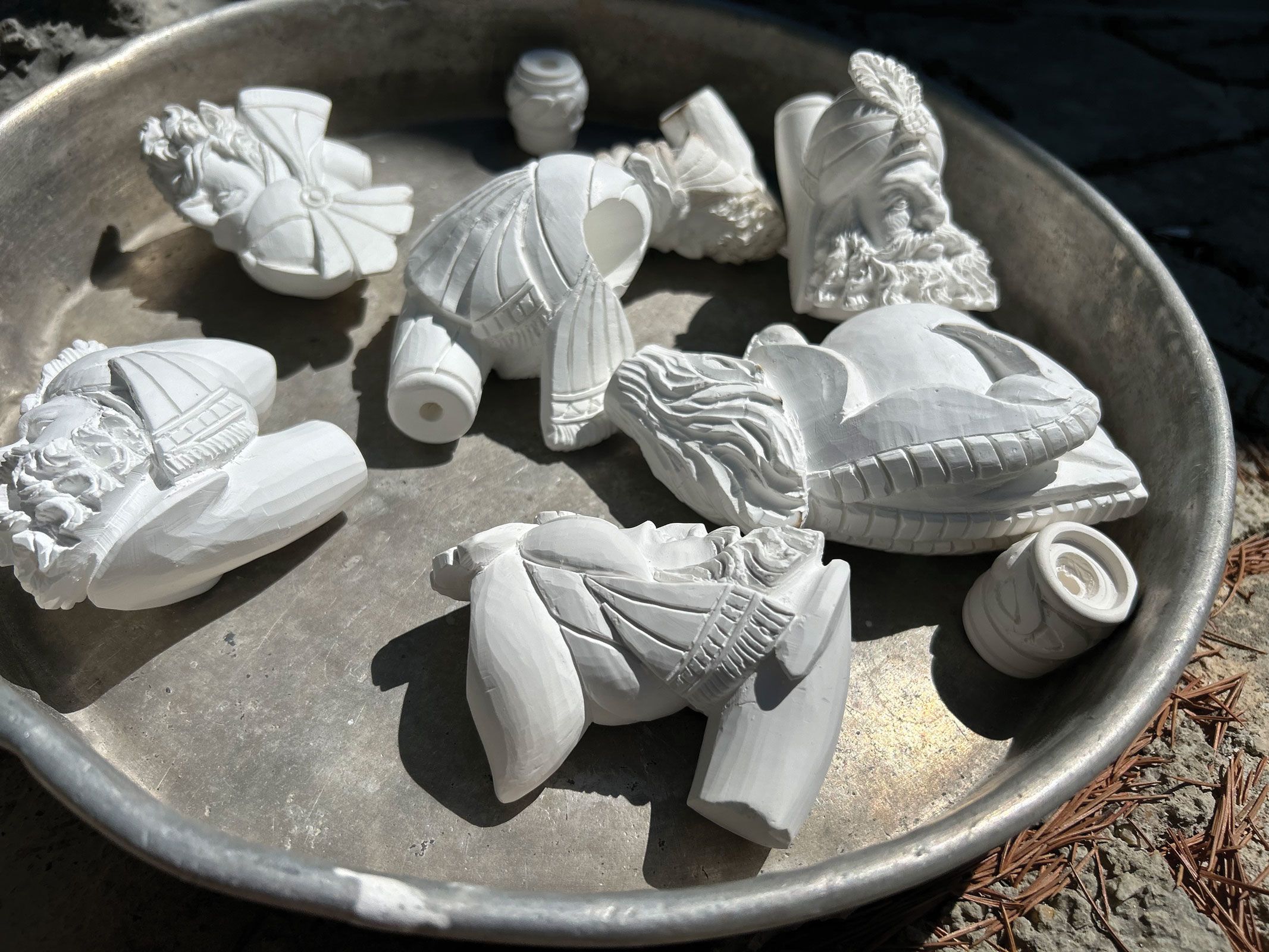
A collection of freshly carved sultan pipes await their stems. (Photo by Justin Fornal)
A collection of freshly carved sultan pipes await their stems. (Photo by Justin Fornal)
When we reached Sinan’s family home, he took me through an extensive maze of terraced gardens. Hundreds of plums, apricots and long, green peppers dried in the sun on massive trays. We walked under an arbor and Sinan cut down a shimmering bunch of green grapes and handed them to me.
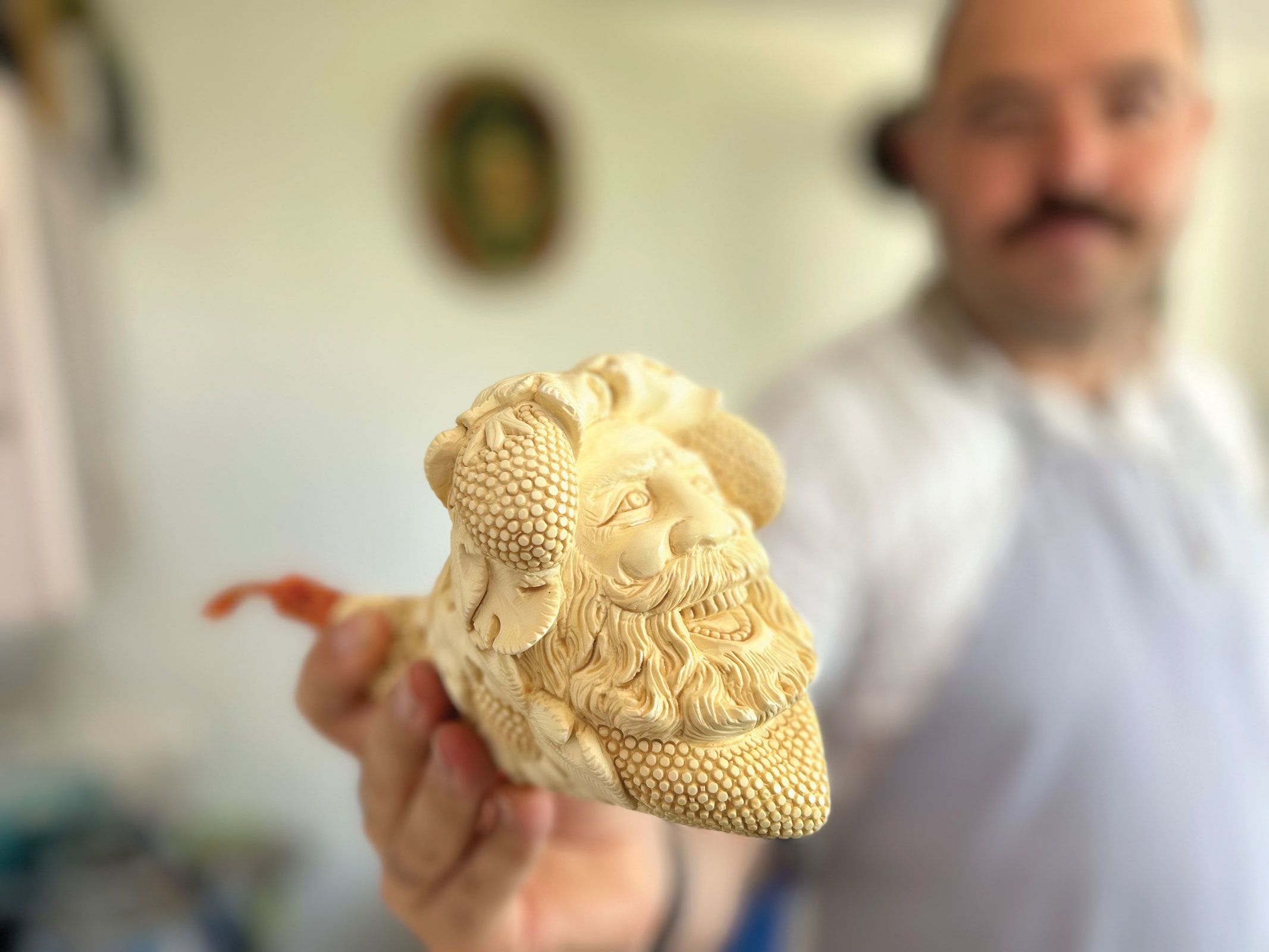
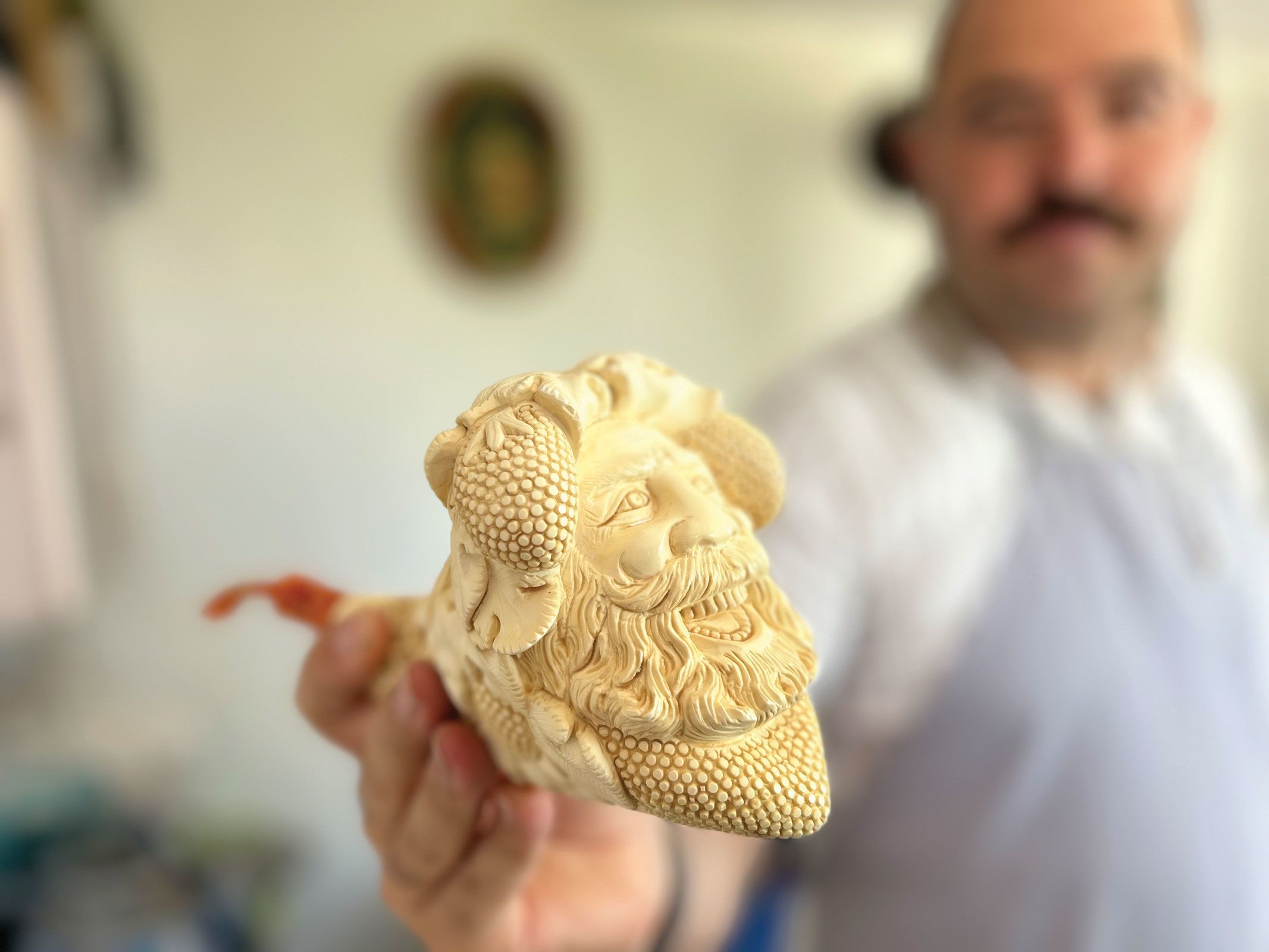
In the back of the stone property was the family workshop. Sinan’s father, Ali Onalci, took a break from carving a pipe depicting a sultan’s face and gave me a warm greeting. Over the next hour, the two master craftsmen give me a crash course on carving meerschaum. As the carving progresses, smaller and smaller tips are used to create finer and finer detail. Cutting into the cool stone and scraping away tiny bits is a strangely calming and mesmerizing practice. Looking at a table full of Onalci family masterpieces, it was clear that their passion is sculpting incredibly detailed faces.

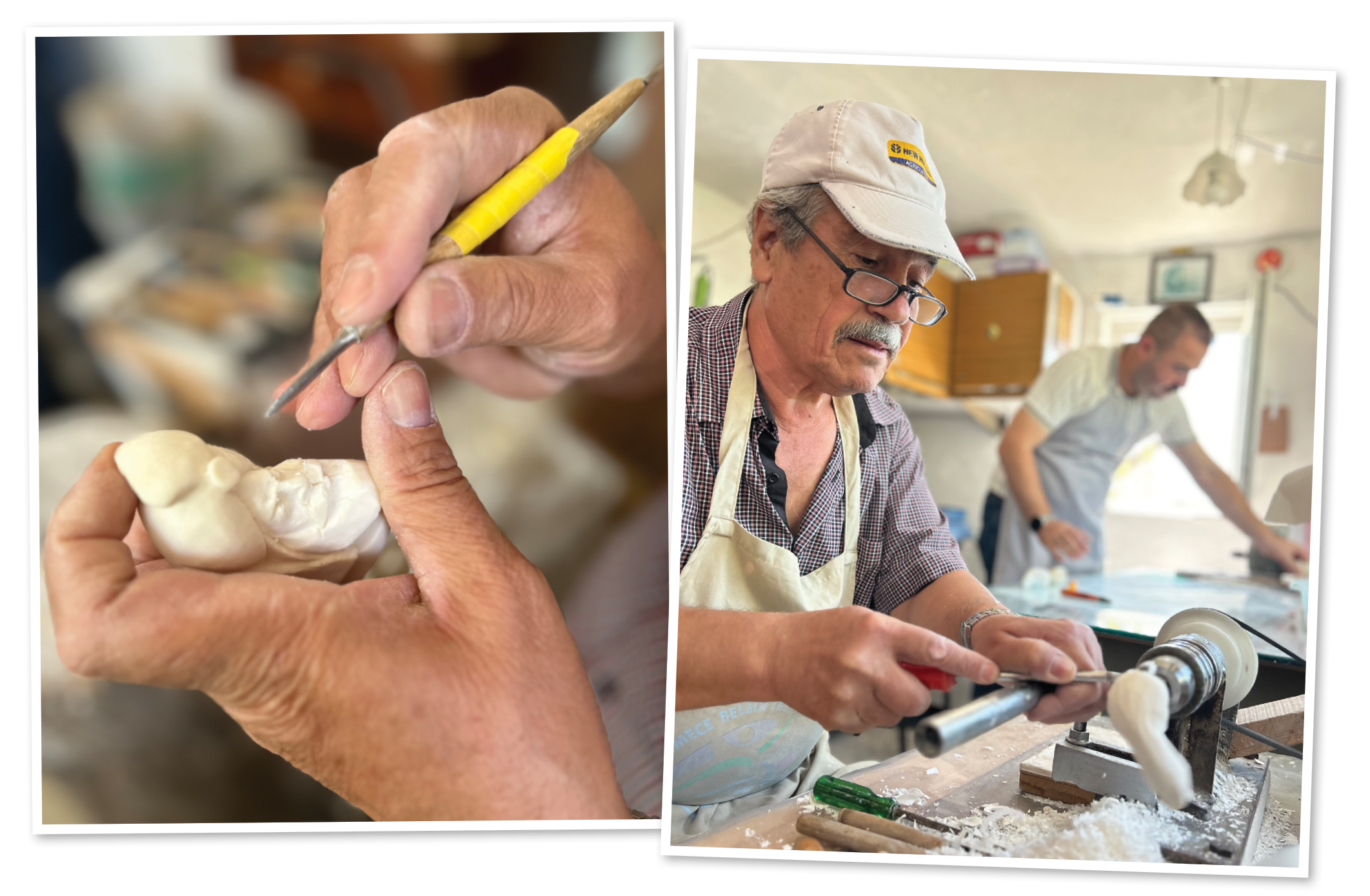
Left, master pipe maker Ali Onalci carves intricate detail into one of his famed sultan pipes. Right, father and son team Ali and Sinan Onalci making meerschaum pipes at their home workshop in Kozlubel, Turkiye. (Photos by Justin Fornal)
Left, master pipe maker Ali Onalci carves intricate detail into one of his famed sultan pipes. Right, father and son team Ali and Sinan Onalci making meerschaum pipes at their home workshop in Kozlubel, Turkiye. (Photos by Justin Fornal)
“We can carve a pipe to look like anyone you want. We’ve carved pipes to look like a customer’s wife or their child. Others like to get a pipe that resembles a famous politician or a character from their favorite movie. Some people just want a pipe to keep as a sculpture; they might never even smoke it. These days our biggest customers are in China. We ship pipes there all the time.”
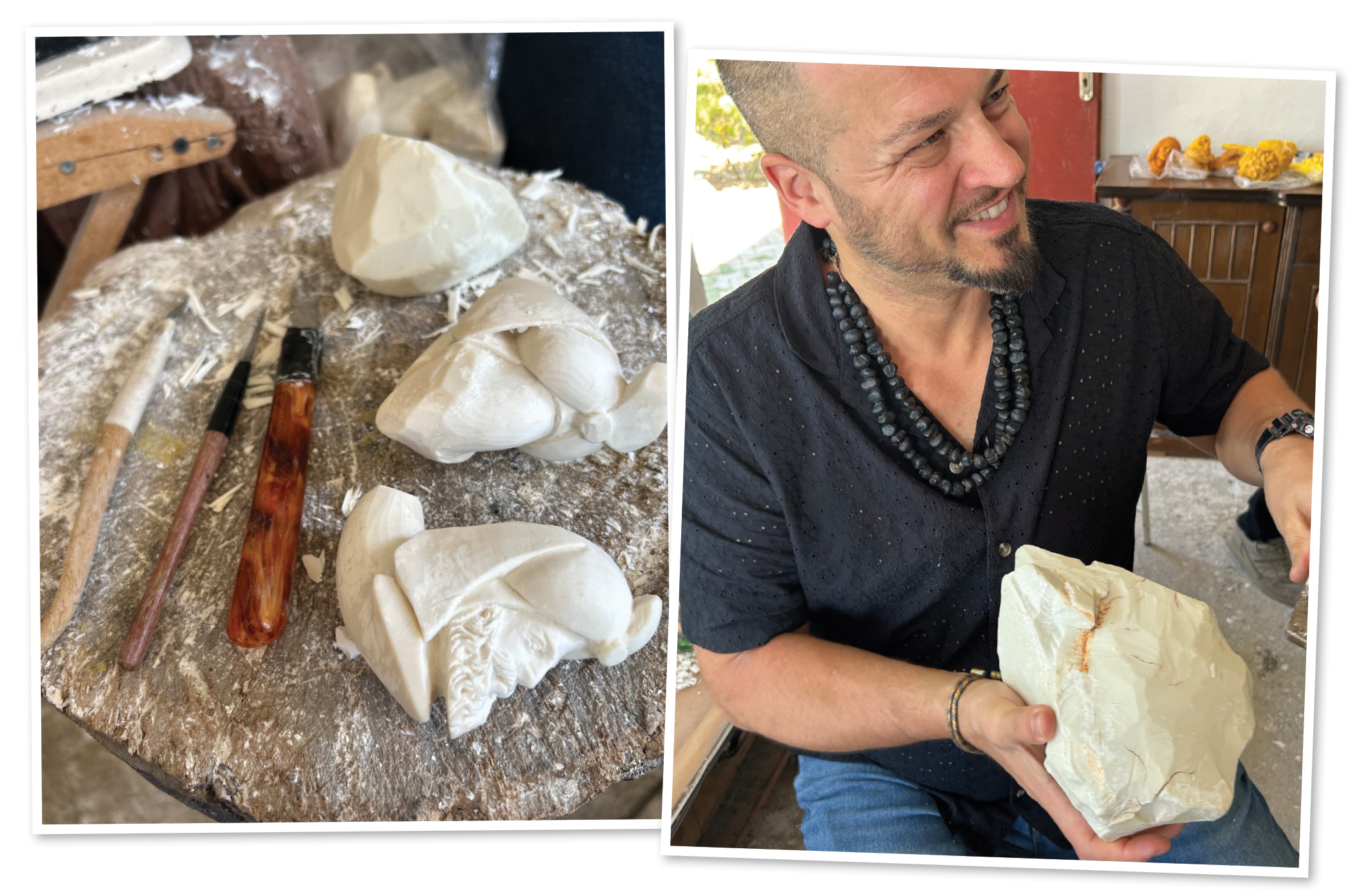
Left, three phases of meerschaum pipe face carving and the tools used. (Photo by Justin Fornal) Right, the author gets a lesson in shaving down a freshly mined piece of block meerschaum. (Courtesy of Justin Fornal)
Left, three phases of meerschaum pipe face carving and the tools used. (Photo by Justin Fornal) Right, the author gets a lesson in shaving down a freshly mined piece of block meerschaum. (Courtesy of Justin Fornal)
Once the carving tutorial was completed, I was invited to the main house for a beautiful home-cooked lunch.
The meal started with a cold glass of the refreshing yogurt drink ayran, followed by rice-stuffed eggplant, olives, spicy beef stew, a variety of homemade breads and spreads and a fresh cucumber and tomato salad. The meal finished with slices of the sweetest watermelon I have ever tasted.

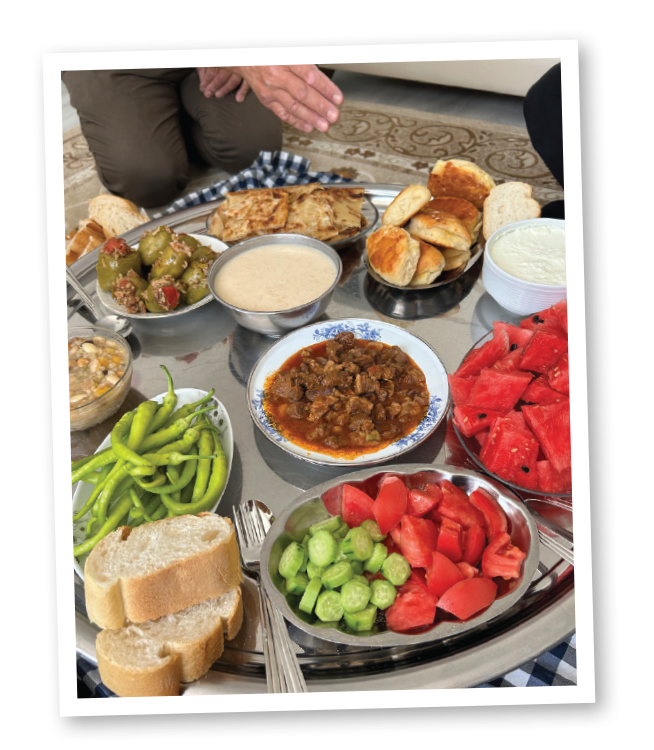
A home-cooked feast at the Onalci home. (Photo by Justin Fornal)
A home-cooked feast at the Onalci home. (Photo by Justin Fornal)
Sinan’s mother, Hatice, who prepared everything, saw my delight and nodded in approval. “Everything you’re eating comes from our property,” she said.
I told them that a carving lesson and meal would be a great tourism business. “It’s a beautiful experience,” I told them.
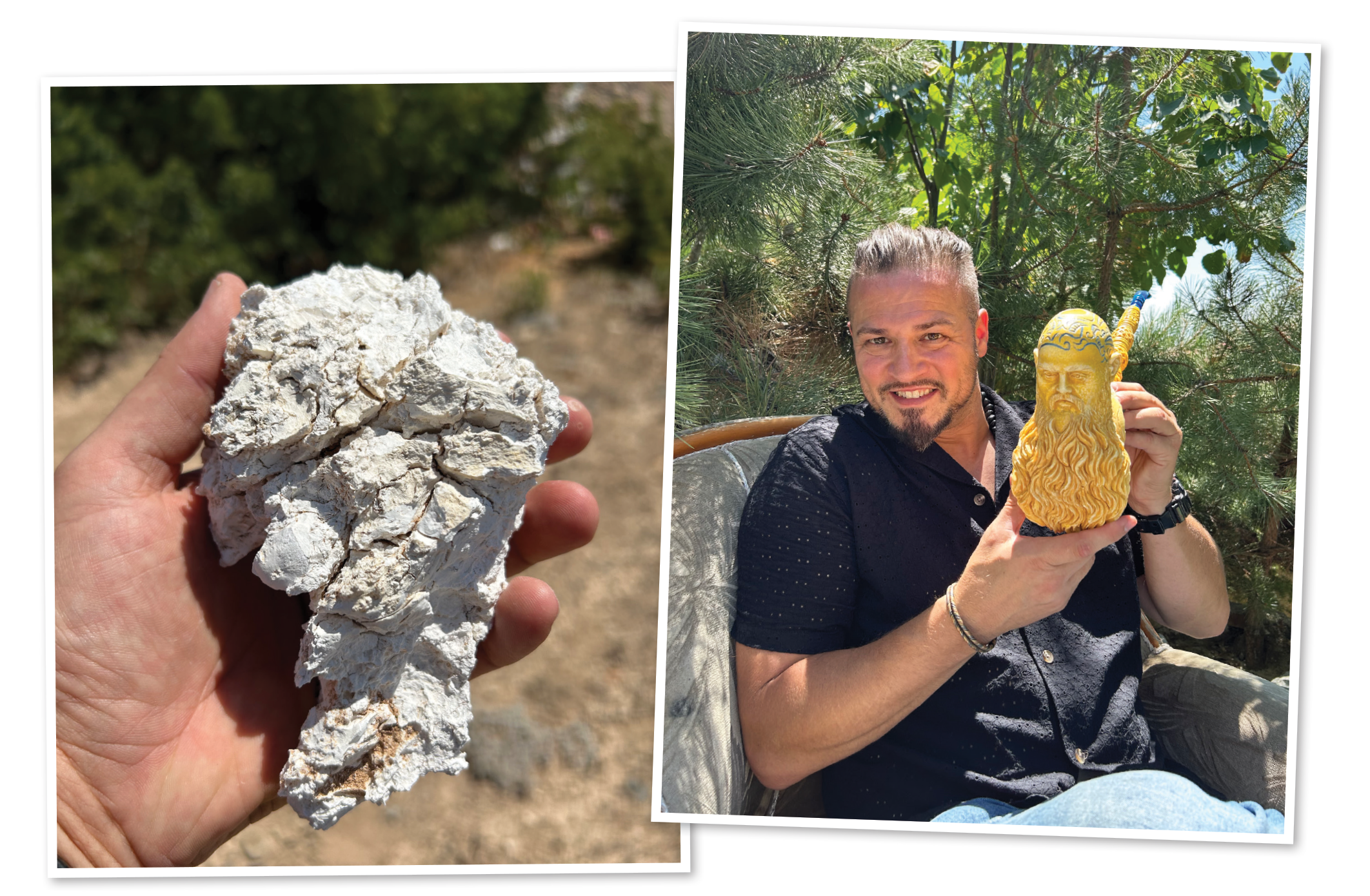
Left, a chunk of block meerschaum pulled from the mines that has been deemed not fit for carving. (Photo by Justin Fornal) Right, the author displays one of Ali's masterpieces. (Courtesy of Justin Fornal)
Left, a chunk of block meerschaum pulled from the mines that has been deemed not fit for carving. (Photo by Justin Fornal) Right, the author displays one of Ali's masterpieces. (Courtesy of Justin Fornal)
Sinan beamed, “This is the real Turkiye. This is still the lifestyle in some of these small towns. Once we finish lunch, I’ll show you the mines. I do not think you should go in, as it’s scary and a bit dangerous.”
I made my case: “I must insist on going into the mines.” I reached into my pocket and pulled out my old travel pipe. “I have had this pipe for almost 30 years, and I need to bring it back to where it was born. My ancestors were coal miners in a town called Wilkes-Barre, Pa. Mining is still in my blood.”
They relented.
An hour later, a group of miners met us at a small hole on the outskirts of town. As I got suited up in coveralls, one of the miners slipped into a sling attached to a hoist frame. He straddled the hole and gave a command. Sinan went into a small shed to activate the lowering mechanism, and a gasoline generator started up. The miner disappeared into darkness.
I was next. I got into the large canvas sling and held on for dear life. Sinan gave me a concerned glare.
“It is 200 feet to the bottom. Don’t let go. It will be bad for us if you die,” he said.
With that, he pushed the crank forward and I started to sink into the Earth. I expected the hole to get wider, like dropping into the chamber of a cave. It never did. In some spots it got even tighter. My shoulders bumped and scraped against the dirt walls, sending bits of crumbling clay down on top of me. The tube-like design is like something out of a Bugs Bunny cartoon. The proverbial rabbit hole I so often find myself going down had now taken on literal meaning. About 15 feet from the bottom, the chute finally opened up, and I was greeted by a group of miners who were waiting in the central chamber. Once Ali and Erhan joined, we began to explore the vast labyrinth of hand-dug passages. They seemed to go on for miles.
Erhan followed me up a tunnel. “This mine was started in 1984. There is still lots of good stone down here. Look at the walls.”
As we scrambled along through the packed-dirt tunnels, I shined my flashlight about and saw beautiful stripes of creamy white meerschaum peeking out. Some veins felt hard and smooth like polished marble. Others, soft, like sculpting clay. Erhan saw me pinching off some of the soft pieces. “You can eat that one. It is good for your stomach,” he said.
I chewed on a quarter-sized bit of ivory white clay. It was cool and strangely pleasing, like eating a chunk of wet-concrete-flavored fondant. I rubbed my old tobacco pipe along the walls and imagined that many years ago it may have been sourced from this very location. After an hour of exploring and, ultimately, mining a few big chunks of stone, we all took a seat near the entrance. I lit my old pipe and listened to the miners tell stories about the old days.
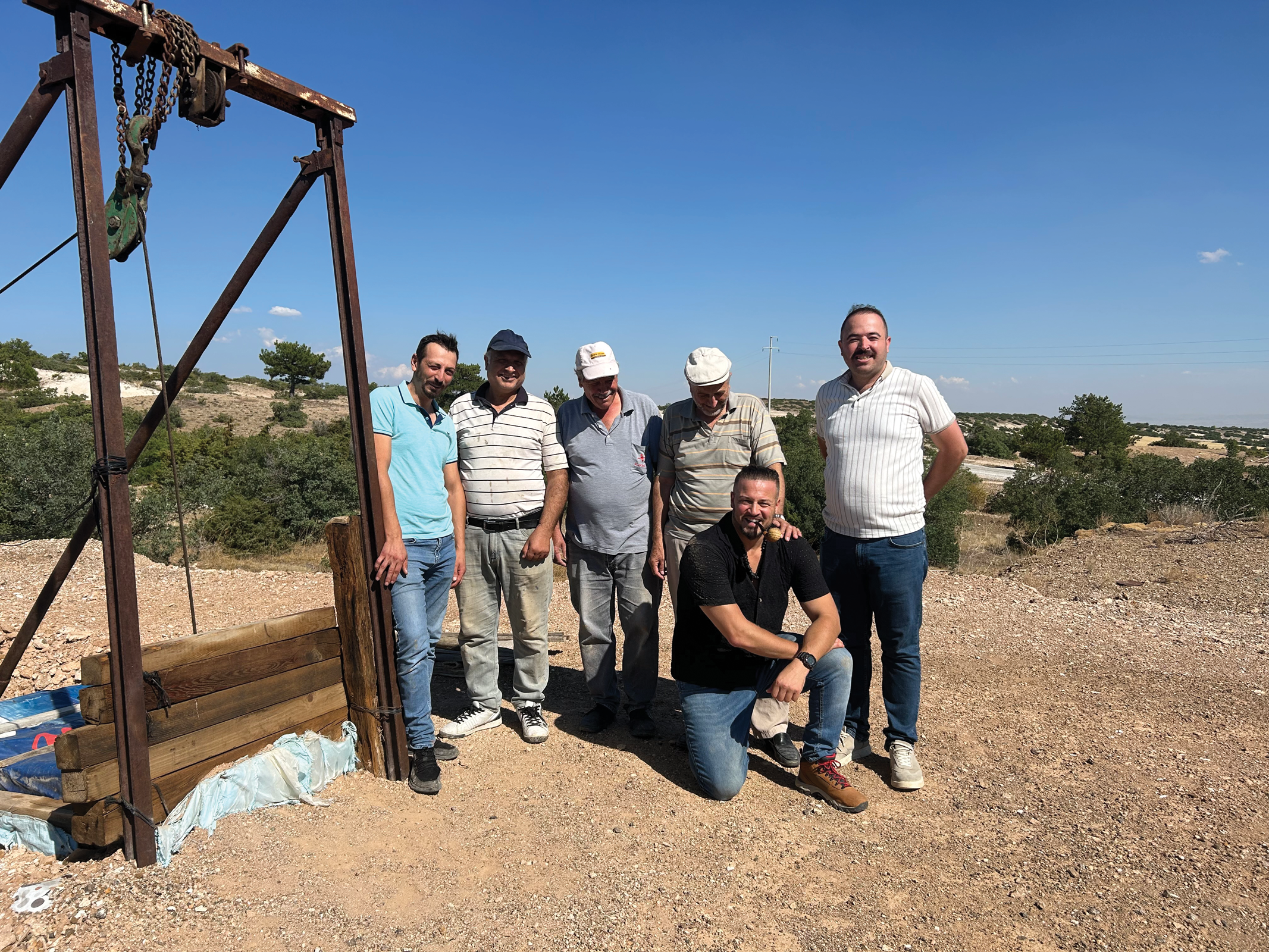
The author (kneeling) is joined by some of Turkiye’s last meerschaum miners at the entrance of a mine. (Courtesy of Justin Fornal)
The author (kneeling) is joined by some of Turkiye’s last meerschaum miners at the entrance of a mine. (Courtesy of Justin Fornal)
One by one, each miner shot back up to the surface using the cable and winch. When it was my turn, Ali remained below to ensure that I got out safely. The ride up was a lot slower than the ride down; the machine was working much harder. I felt a strong vibration coming through the cable as the old generator labored away. Then, with a sudden jolt, I stopped ascending. At that point, I was only halfway up. A hundred feet above, a hundred feet below. I dangled in the silent darkness for several disheartening minutes. I saw an old safety rope running the height of the shaft. I reached out with one hand and wrapped the rope around myself. If the cable did let go, I might have a chance by holding onto the rope and climbing out. I heard yelling up top and suddenly I felt the cable lowering me back down toward the bottom. I held on and braced for anything.
When I landed at the bottom, I saw Ali.
“I weigh 100 kilograms,” he said. “How much do you weigh?”
“I weigh 120.”
Ali scowled and spoke Turkish into an intercom.
“You are too heavy to get out,” he finally said.
I laughed nervously. “I guess we should have done this before lunch.”
“We will call my cousin to come with a stronger machine.”
An hour later, Ali’s cousin came zipping down using a second harness. He said hello, handed me his harness, took mine and zipped back up.
This second rig came with a large handheld controller enabling the rider to ascend and descend with the push of a button. I climbed into the sling and pushed the up button. Nothing happened. Ali pushed on some wires that seemed loose and it started.
“Go quickly while it’s still working. Do not let go of the wires.”
I wrapped my arms tightly around the sling, pushing the wires into the controller with my right hand and pushing the up button with my left. I took a deep breath and began to slowly eke my way back to the surface. The light of the sun got closer, and soon I could see some miners looking down at me. About 10 feet from the surface the machine stopped again.
Erhan yelled down to me, “Now you must climb.”
Fortunately, the remaining distance was framed with wooden timbers that I could grip. Still, I realized that if I slipped there was nothing to stop me from falling all the way down. I carefully grabbed onto the wood and slid my body out of the sling, then cautiously climbed the timbers as one would a ladder.

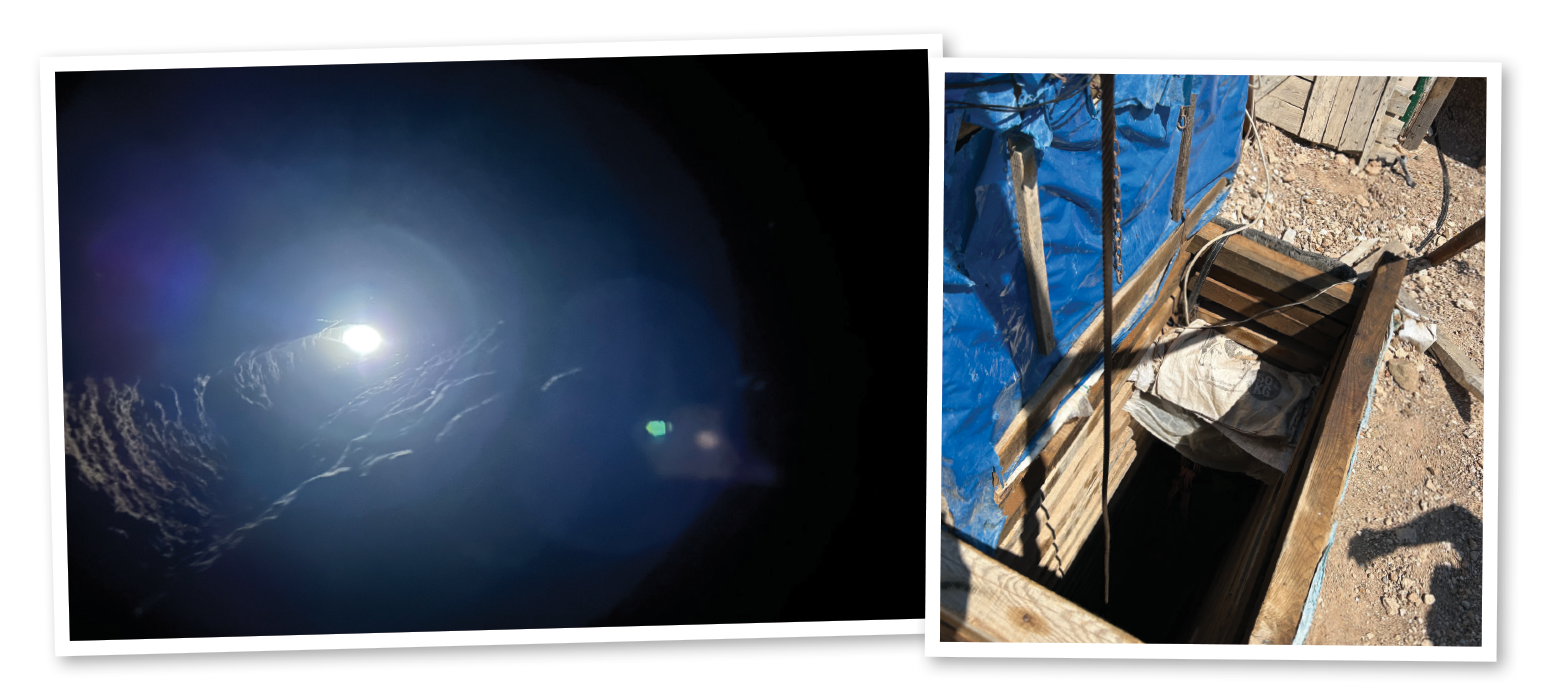
Left, the author’s view to the surface while dangling precariously from a halted winch. Right, the entrance to an almost 200-foot shaft that leads to an active meerschaum mine. (Photos by Justin Fornal)
Left, the author’s view to the surface while dangling precariously from a halted winch. Right, the entrance to an almost 200-foot shaft that leads to an active meerschaum mine. (Photos by Justin Fornal)
As I got closer to the opening, I saw several hands reaching down to grab me. I asked them to please stand back and then hurled my body over the edge, tumbling onto the ground. Everyone cheered as I stood, dusted myself off and took a dramatic bow.
“Gentlemen, thank you for your patience. I promise to go on a diet before my next trip.”
Back at the house, I purchased one of Ali’s freshly carved pipes and a few other pieces of his handmade ephemera. As I began to walk toward my car for the drive back to Istanbul, Ali requested to see the pipe I had brought from home. He held it in his hands and inspected it with an expert eye.

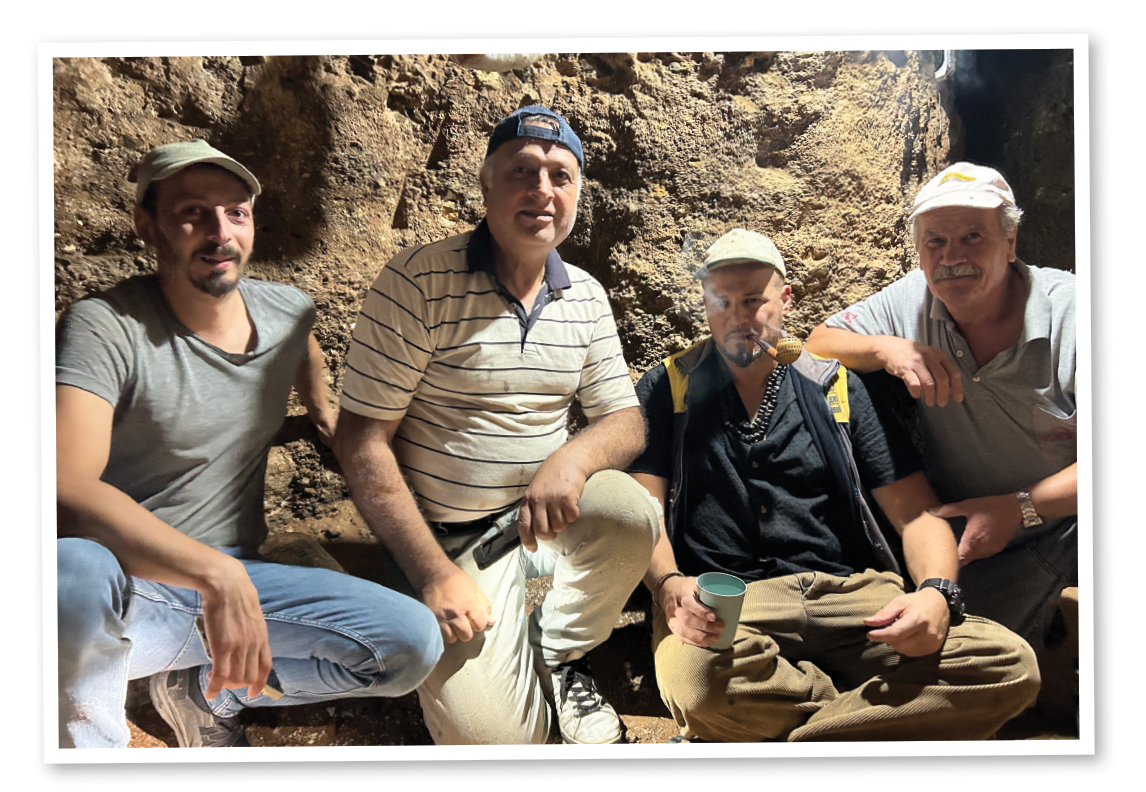
The author enjoys his favorite pipe and some cave-cold water with Ali Onalci and some fellow meerschaum miners. (Courtesy of Justin Fornal)
The author enjoys his favorite pipe and some cave-cold water with Ali Onalci and some fellow meerschaum miners. (Courtesy of Justin Fornal)
“Sinan tells me this meerschaum has traveled with you around the world. It makes me happy when I hear about a pipe that has become more than just a pipe. That old piece of meerschaum brought you here to us and now we are friends. There is some magic in that, and I am thankful for it.”
I spoke from the heart: “So am I.”