


To the land where elephants dance
Documentarian Kim Frank was drawn to investigate the mysteries of elephant migration routes in Northeast India. What she discovered was magical and profound.
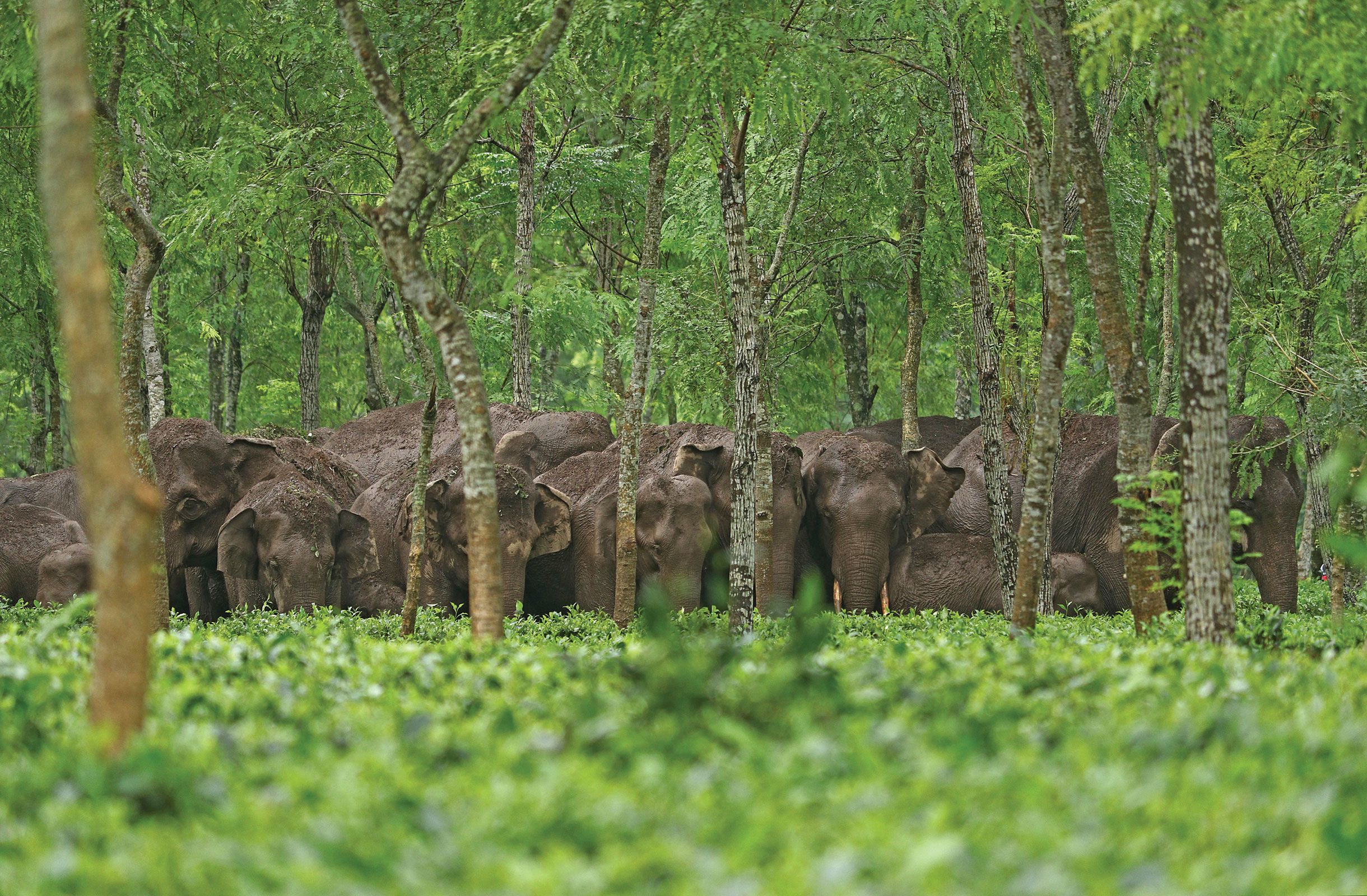

To the land where elephants dance
Documentarian Kim Frank was drawn to investigate the mysteries of elephant migration routes in Northeast India. What she discovered was magical and profound.
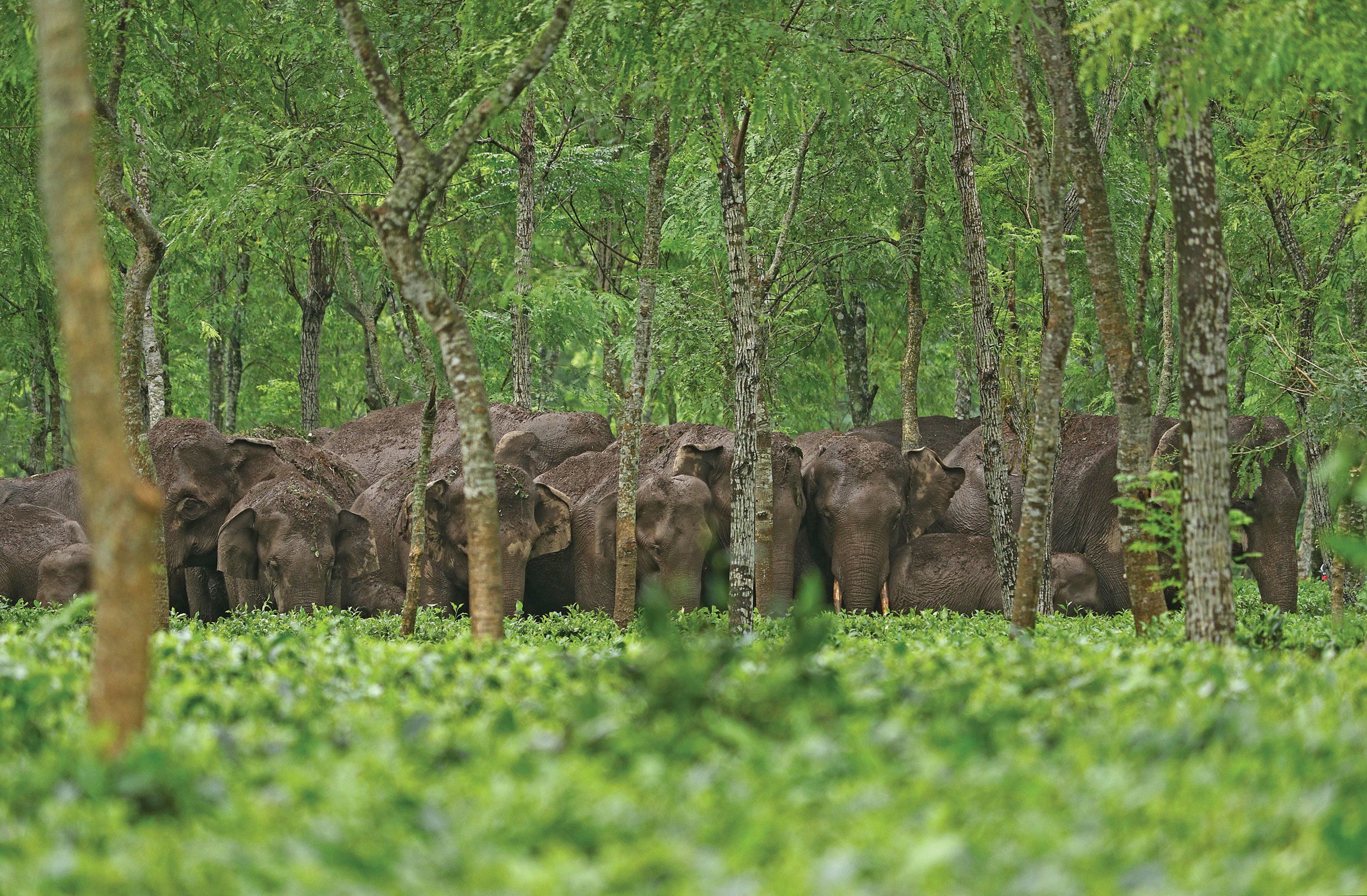

Some people contact travel advisors to join a tour, relax at a resort or book a cruise. Others may seek to satisfy a long-held curiosity, or experience a place that has always intrigued them, or return to a destination that holds special meaning. They are going on a personal quest.
In the fourth of our occasional series of stories about such trips, writer, filmmaker and explorer Kim Frank engages a driver and photographer to join her on a journey to a remote corner of India. Their quest? To find evidence that elephants are still living in a forest in Eaglenest Sanctuary — at an elevation just shy of 9,800 feet, it’s the highest elephant habitat ever recorded.
The moonlight showed it all iron gray, except where some elephants stood upon it, and their shadows were inky black. Little Toomai looked, holding his breath, with his eyes starting out of his head, and as he looked, more and more and more elephants swung out into the open from between the tree trunks.
— “Toomai of the Elephants,” Rudyard Kipling
In his short story “Toomai of the Elephants,” Rudyard Kipling imagined an Asian tusker named Kala Nag, captured from the jungles of Assam. One night, Kala Nag carried Toomai, a child mahout (elephant minder) to join the legendary “elephant dance.” Told in myth, elephants will gather, sway and thunder with roars until dawn, after which they slip away like apparitions, leaving only masticated grasses as proof of their revelry.
The mystique of the Northeast India jungles and the eastern Himalayas has long beckoned to adventurers, explorers and artists. In this 21st century age of development, population explosion, ease of remote travel and social media, the chances of encountering a secret elephant dance in a moonlit forest would be a rarity indeed. Even so, stories from this region continue to captivate and inspire. Is there, I wondered, still something profound and magical left to discover?

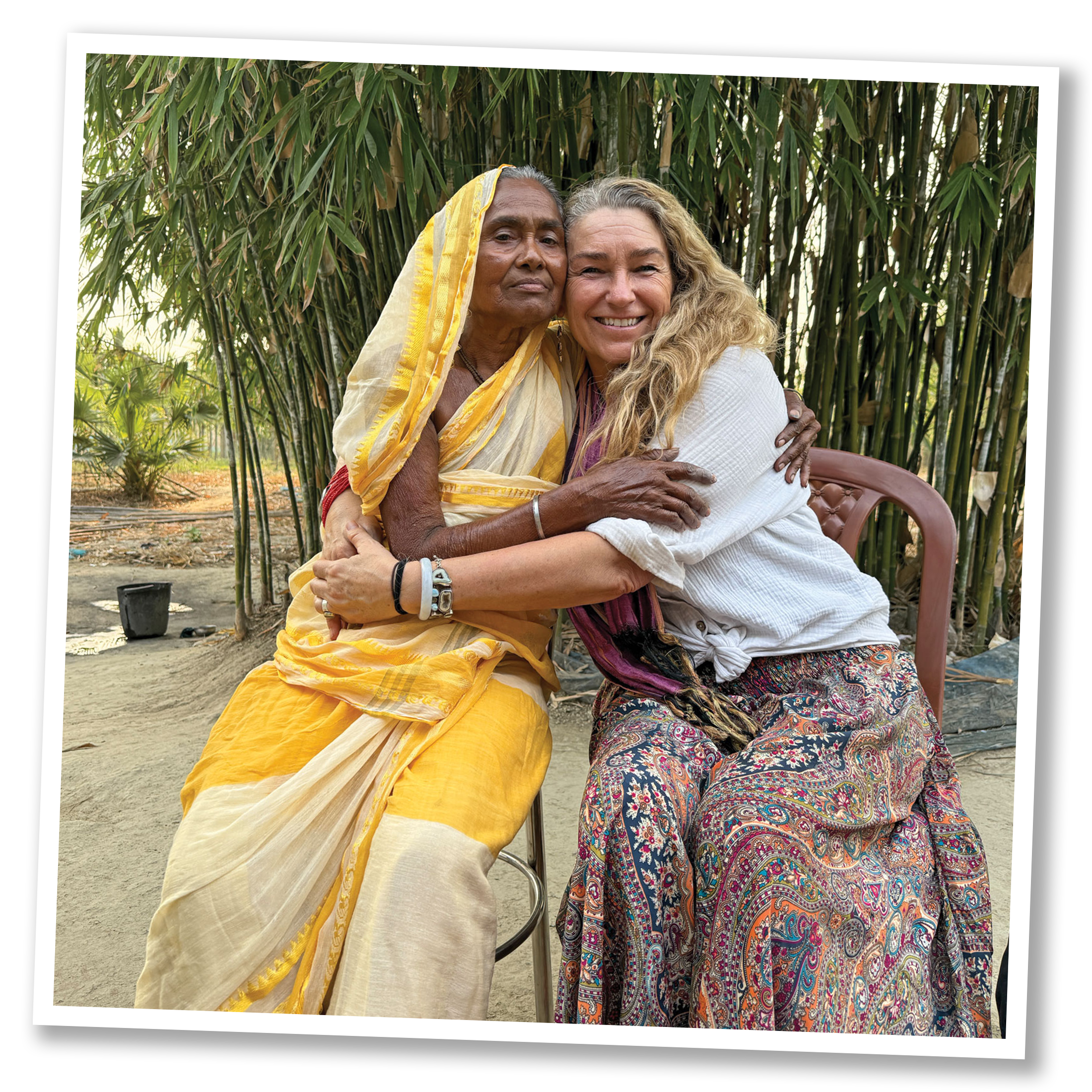
Near Manas National Park, comparing hair and offering oil. (Photo by Sourav Mandal)
Near Manas National Park, comparing hair and offering oil. (Photo by Sourav Mandal)


A cafe tucked along the highway gives a hint to local history and legend of the Shertukpen warriors of Arunachal Pradesh. (Photo by Kim Frank)
A cafe tucked along the highway gives a hint to local history and legend of the Shertukpen warriors of Arunachal Pradesh. (Photo by Kim Frank)
Today, Asian elephants face grim odds to survive in the wild. Once numbering in the hundreds of thousands, only 40,000 to 50,000 remain, 60% of them in India. In their struggle as humans encroach into their habitat, approximately 450 people and 100 elephants die each year. A disproportionate number of casualties occur in North Bengal, bordered by Nepal, Bangladesh and Bhutan, and within sight of Kanchenjunga, the third-highest mountain in the world. When I learned of this crisis, I was told the story was too complicated, risky and complex to try to tell. But it became my quest to give voice to a conflict hidden from the wider world.
Over seven years, I returned repeatedly to India’s borderlands. I wrote articles, completed a book, “Elephants in the Hourglass” (Pegasus Books, January 2025), and filmed a feature documentary, “Where the Forest Roars.” Yet when the film was finished, my journey wasn’t. I felt pulled to follow the 1,430 miles of ancient elephant migration routes, traveling beyond Bengal into Kipling’s Assam, and farther yet to Arunachal Pradesh, the “Land of the Rising Sun” in the remote northeast corner of India.
Each day’s first light touches Dong village in Arunachal before spreading across the subcontinent. Bordered by Tibet/China, Myanmar and Bhutan, this state holds the world’s second-largest monastery; 80% of its forests are intact. Among the Adi, Mishmi and Apatani peoples, elephants are regarded as ancestors, spiritual guides and companions. The herds follow the Siang River, which begins as Tsangpo in Tibet before becoming the Brahmaputra and, eventually, joining the Ganges. To trace the elephants was to trace India’s lifeblood itself. I had read that elephants were recorded living just shy of an altitude of 9,800 feet in Arunachal’s Eaglenest Sanctuary, the highest elephant habitat ever recorded. Could I reach it? What might I find?

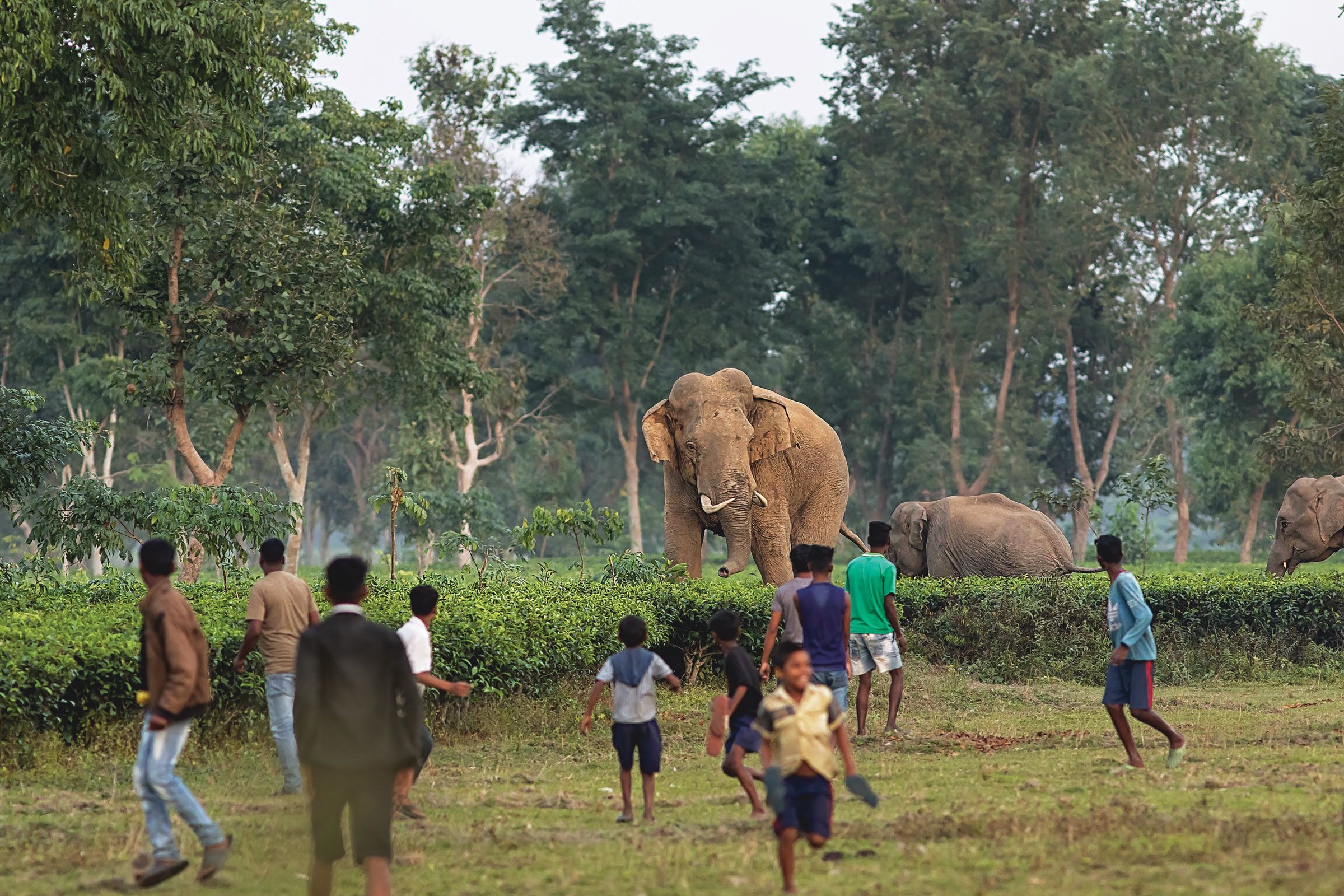
Families who live in tea garden villages sometimes clash with elephants. India is home to 60% of the Asian elephant population. (Photo by Avijan Saha)
Families who live in tea garden villages sometimes clash with elephants. India is home to 60% of the Asian elephant population. (Photo by Avijan Saha)
In search of 'Baba'
My team was small: Sourav Mandal, wildlife photographer and cinematographer for “Where the Forest Roars,” and Anil Bishwarkarma, our steady driver who always says “yes” when asked, “Can we …?” Wildlife Trust of India, a nonprofit that builds safe passages for elephants across the country, assisted us. Our plan was to follow the migration routes and gather stories from those who have lived with elephants for generations. If time allowed, we’d push for Eaglenest, though I accepted that might not be possible.
Passing through emerald tea estates and into parched landscapes, we arrived in Raimona, Assam. Once a place where the Bodo people fought for independence, it’s now home to a new wildlife sanctuary and ecolodges. We were met with peaceful enthusiasm. By firelight, we spoke with a former fighter while his daughter quietly wove a saffron and red dakhona (a traditional dress). Later, she dressed me in one, and we laughed — that gift that crosses language.

A woman spins thread for weaving in Raimona. (Photo by Sourav Mandal)
A woman spins thread for weaving in Raimona. (Photo by Sourav Mandal)
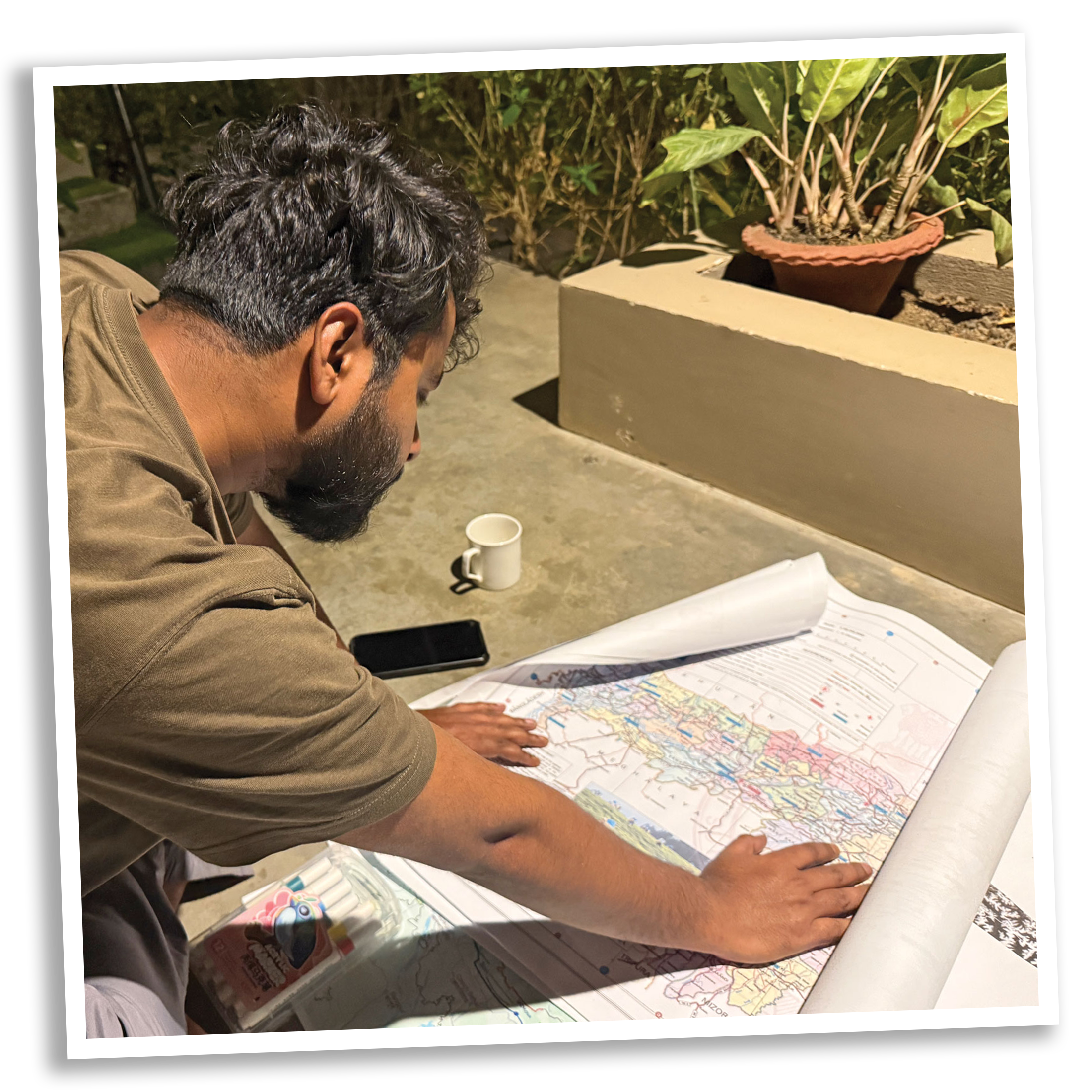
Wildlife cinematographer Sourav Mandal mapping the route for Frank and her team. (Photo by Kim Frank)
Wildlife cinematographer Sourav Mandal mapping the route for Frank and her team. (Photo by Kim Frank)
In another village, we visited a family that lives at the entrance of an elephant path from Manas National Park. “We call all elephants Baba,” the father says. “They are the god of the forest.” His wife leaves the first rice harvest in a bowl at the trail, waiting until an elephant has eaten before the family enjoys a meal themselves. “We’ve never had a problem with elephants in our crops or fruit trees,” he says. “They walk right past as if they are pleased with our devotion to them.” He recalls waking as a boy to find an elephant trunk reaching through his bedroom window for bananas. His uncle calmly said, “Go, Baba.” The elephant obeyed.
Along the route, people told me stories of bonds with nature broken through war and deforestation. They showed me their efforts to repair them: replanting forests, rewilding, teaching children, reweaving coexistence. In Kaziranga National Park I saw elephants, tigers and rhinos thriving in the wild. Women along the elephant routes often dressed me, offering to oil my hair, teach me to weave and make fans with palm leaves and bamboo. A sense of universal sisterhood.
But my allotted time was running out. Sitting by the Sian River, I thought about all I’d experienced so far. I tried to convince myself it could be enough, yet I couldn’t let go. Eaglenest Sanctuary was a 12-hour drive away, but did we have the proper permits to enter that part of Arunachal Pradesh? We had four days left. My teammates said, “Let’s try.”

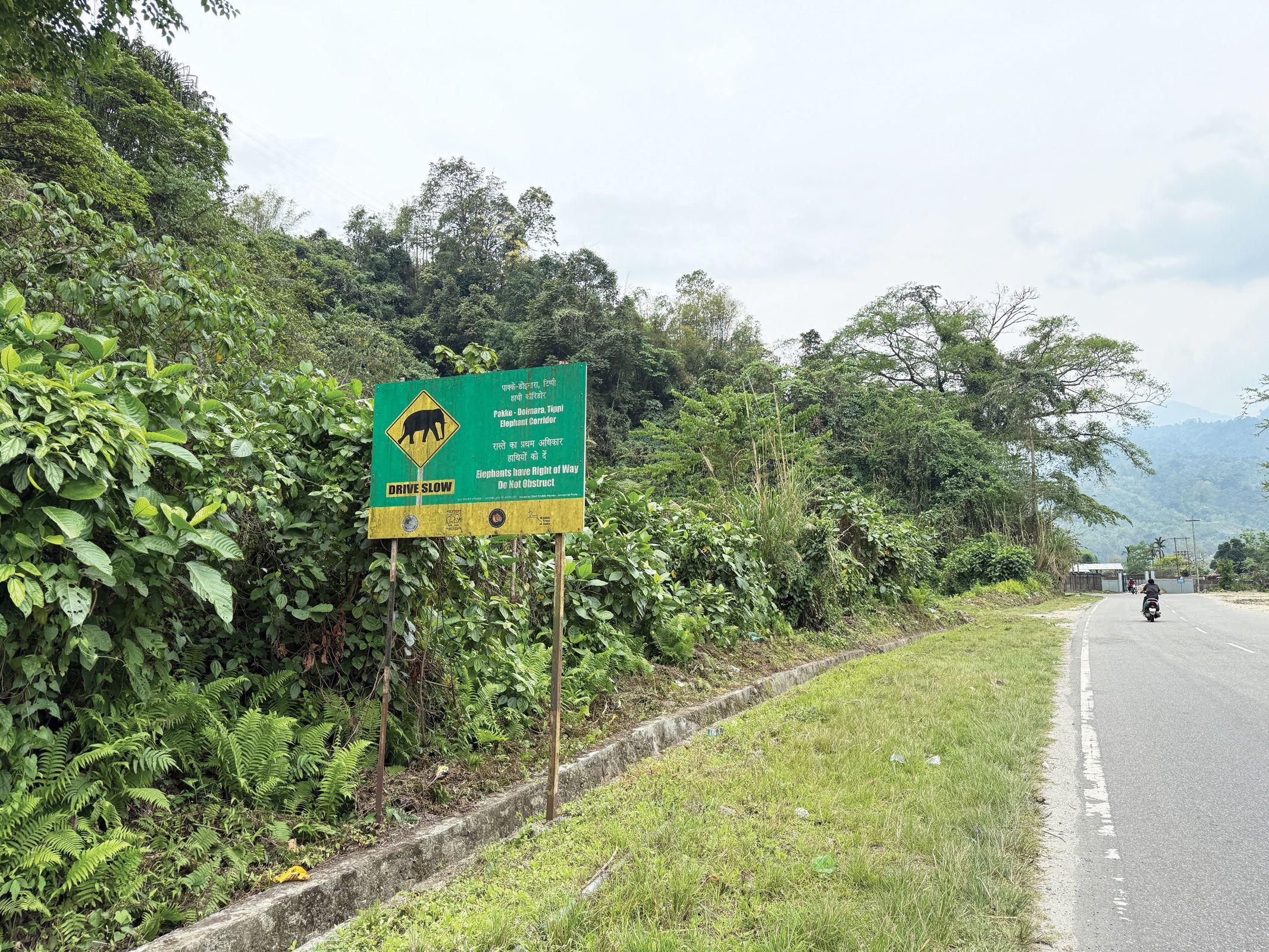
Elephants regularly traverse this highway in Assam, crossing from forest to river. (Photo by Kim Frank)
Elephants regularly traverse this highway in Assam, crossing from forest to river. (Photo by Kim Frank)
The checkpoint was a thrill. Signs forbidding unpermitted travelers and announcing “The Land of the Rising Sun” shored up my confidence and excitement. Papers stamped, we began the long climb. Sharp mountain peaks in a distance gave way to valleys of verdant hills touched with silver and winding rivers. Layers of colorful prayer flags, alternately bright or faded and ragged, lined hilltop temples in bright reds and whites. As we hugged the tight turns of the helix highway, I leaned out the open window, marveling at the waterfalls bursting forth from rocks above us that streamed into the sliver of river far below.
I imagined our next lodging would be nestled in a forest grotto. But no, the town was not a mystical cloud forest. Rather, it was a way station and armed forces base. Military signs and slogans took over the highway, which was being expanded, leaving dirt scars and erosion.
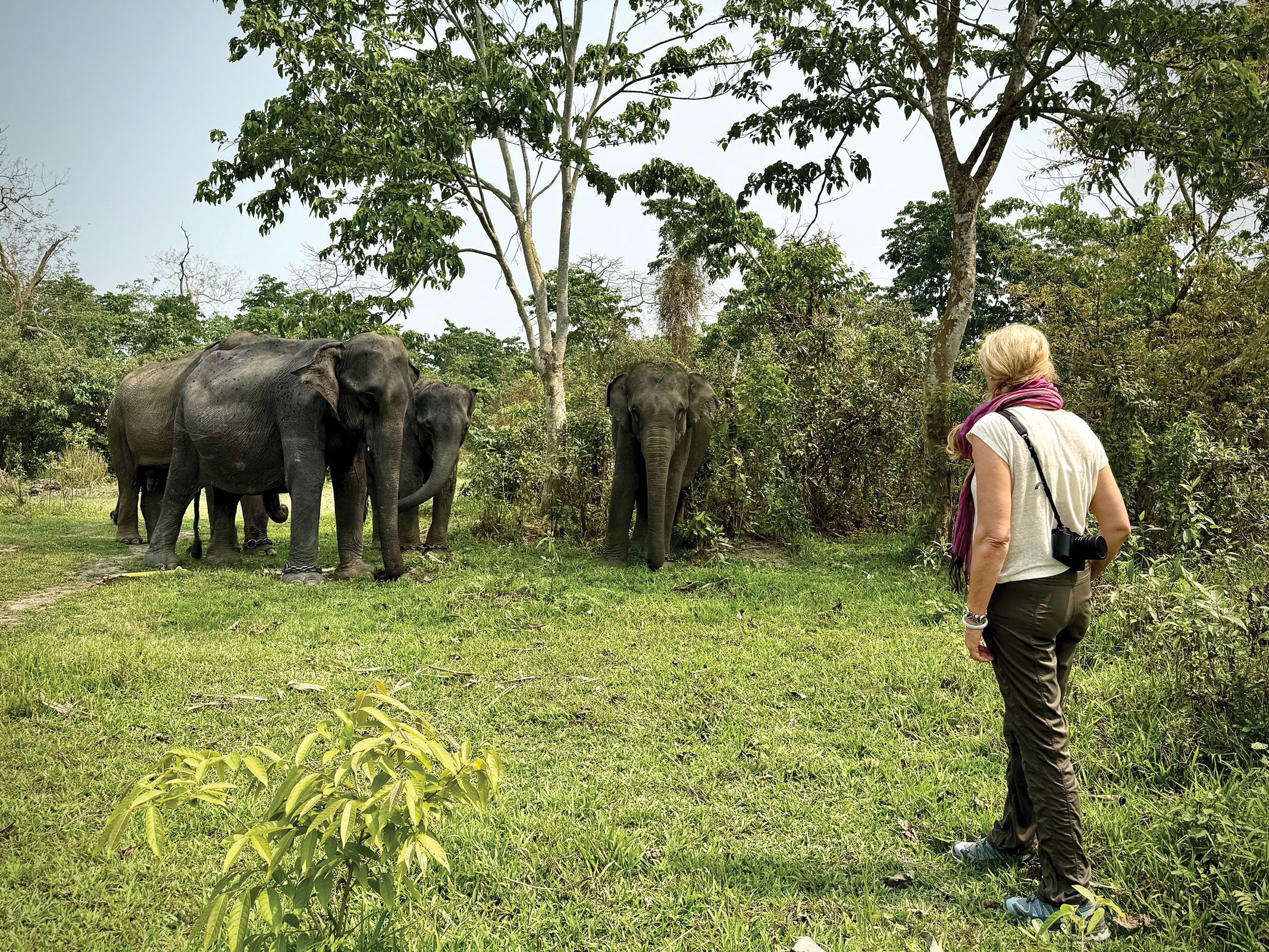
Author Kim Frank observing captive elephants having their medical checkups at Kaziranga National Park. (Photo by Sourav Mandal)
Author Kim Frank observing captive elephants having their medical checkups at Kaziranga National Park. (Photo by Sourav Mandal)
Ascending a vertical ark
The Eaglenest Residency is run by members of the Bugun tribe who are the namesake of a rare bird, the Bugun liocichla, whose only habitat is in the forests surrounding Eaglenest. Photos of the bird were scattered throughout the lobby of our hotel, which was at capacity. We asked the front desk clerk about hiring a guide to take us up into the Eaglenest Sanctuary; it appeared we wouldn’t be able to reach the summit the next day — our last — so we settled for the lower camp as a destination.
We would leave early the next morning. Sourav was hoping to photograph a rare butterfly, the Bhutan glory. He understood how unique this area was more than I did. The sanctuary is renowned as a vertical ark, rising from 1,600 feet to over 11,500 feet. In the short span of 120 miles, one moves through bands of distinct topography, a compressed version of the entire eastern Himalayan biodiversity spectrum. There are over 450 species of birds, 164 species of butterflies, rare snakes and lizards, Asiatic black bears, red pandas, Asian golden cats and the elusive clouded leopard. Interestingly, the lists of flora and fauna I discovered online did not mention that elephants populate the entire region as part of the Kameng Elephant Reserve.

Lunch at Eaglenest Residency. (Photo By Kim Frank)
Lunch at Eaglenest Residency. (Photo By Kim Frank)
At dawn, a loudspeaker chanting and singing Hindu prayers overwhelmed the sounds from the army drills and river rushing below. Soon, honks of trucks traveling the busy highway joined in. The view out my window was a sea of corrugated metal roofs covering an intricate network of courtyards and homes. Vertical prayer flags flapped along the riverbanks. At the end of the hall was a small balcony with a river view, and prayer flags lined a narrow walking bridge that swayed in the wind. The previous day, feeling discouraged by our less-than-natural surroundings, we had taken a walk across that bridge, hoping to feel close to nature again. We had to pick our way through the town garbage dump, skirting cows, watching our steps. The prayer flags, alluring from a distance, had lost their appeal. We sunk into silence. My hopes of finding an untouched, high-altitude magical forest where elephants roam was looking bleak.

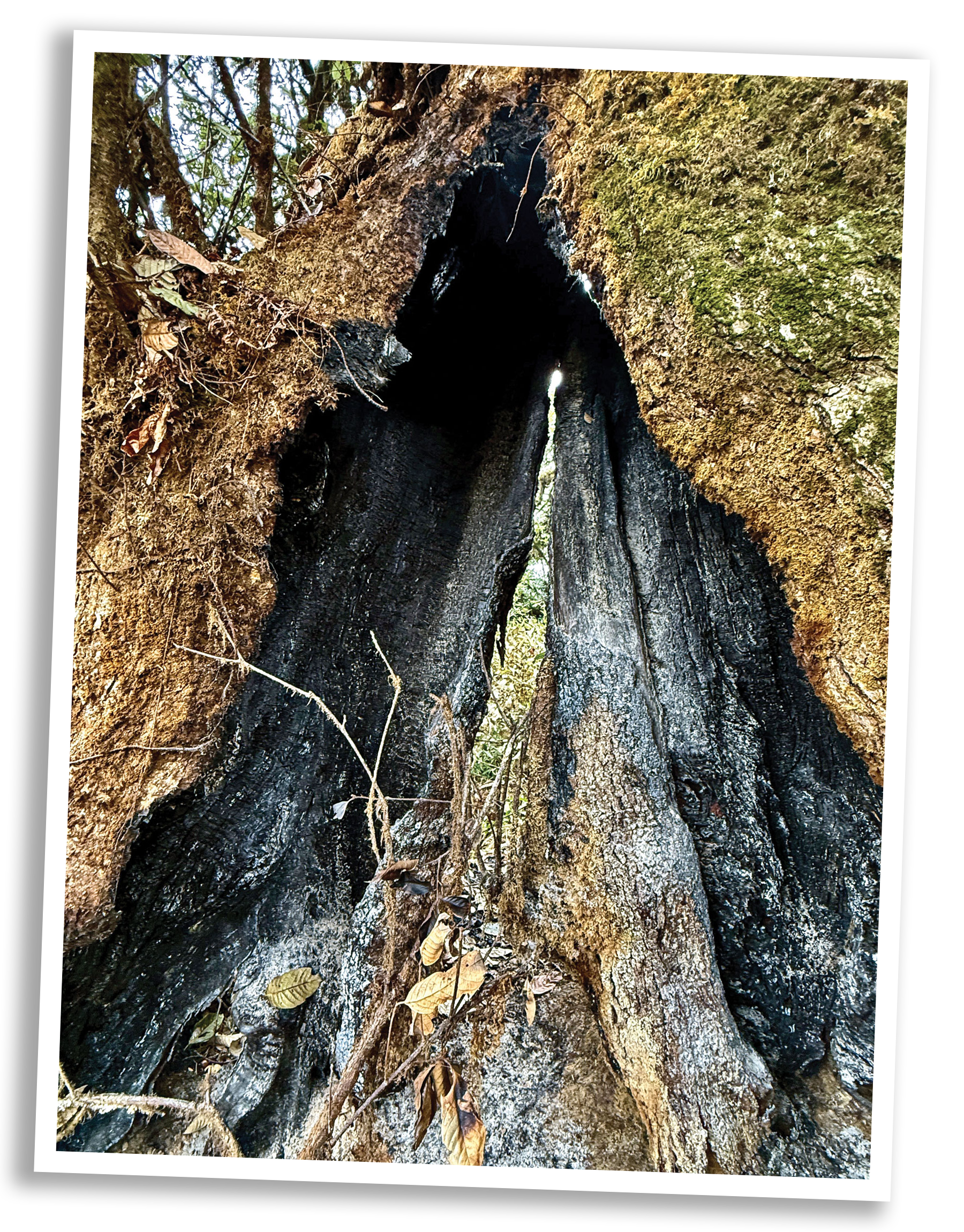
Burnt openings at the base of some trees. The remains of incense and joss paper within indicate prayer sites. (Photos by Kim Frank)
Burnt openings at the base of some trees. The remains of incense and joss paper within indicate prayer sites. (Photos by Kim Frank)
After a winding drive, the landscape opened onto uninterrupted hills and valleys. We stopped at the lower-elevation camp. While Sourav searched for butterflies, I wandered off alone and saw clusters of daisies growing from what looked like small mounds of dirt. On closer inspection: fresh elephant dung! My mood soared. I ran up the other trail to tell Sourav what I’d seen.
When I reached him, there were two English-speaking hikers with a guide trekking down the trail. “We just came from Eaglenest Pass,” said one of the men. “We saw elephant dung everywhere up there on the road.” The guides talked to one another and then told me, “Yes, it’s common. They are traveling through all this area. They use the car road for ease and often eat in the forests around this camp. They come regularly over the pass. I think maybe 20 were there a few days ago. It’s their traditional route.” I asked the hikers how far it was to reach the pass. “It’s about another hour drive from here.” We got back into the car and began to drive.

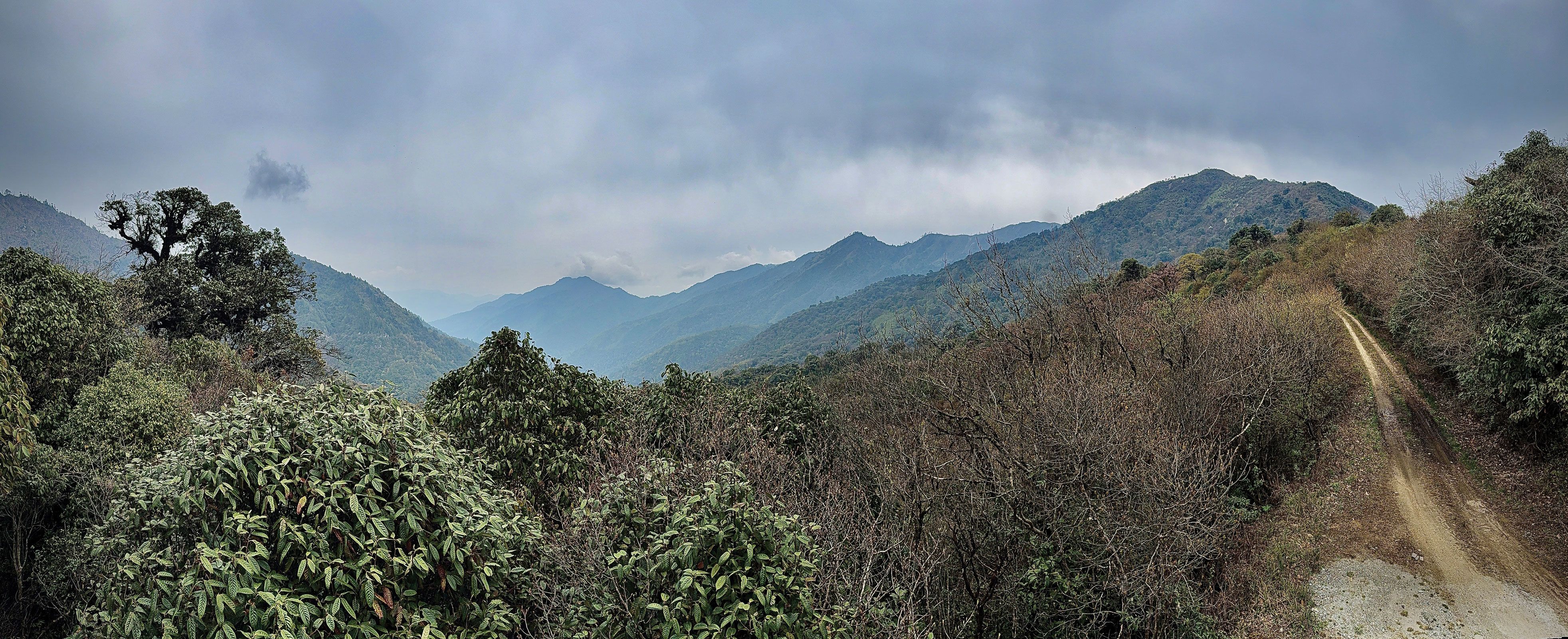
Pressing on to the highest point at Eaglenest Pass. (Photo by Kim Frank)
Pressing on to the highest point at Eaglenest Pass. (Photo by Kim Frank)
Following in their dance steps
At 9,186 feet, Eaglenest Pass is gray, cool and quiet. Sourav, the driver and the guide walk up the road. I was captivated by the white khatas (Buddhist scarves) fluttering from tree branches. They marked an entrance to a wooded trail that disappeared up a hill. I started walking. The ground was damp and dark, thick with oaks with gnarled trunks and hanging moss, fir trees, clusters of bamboo and wild rhododendron blooming white and purple. Through the clearing, clouds drifted through the higher forests, looking like the mystical landscape I had imagined and always hoped to find. The khatas hung near hollowed out tree trunks with burnt openings at the base. Inside were scraps of prayer papers and incense. This path appeared to be a natural temple. I was embraced by a dense forest that seems to defy time. Something caught my eye: a large indent in the dirt.
An elephant footprint.
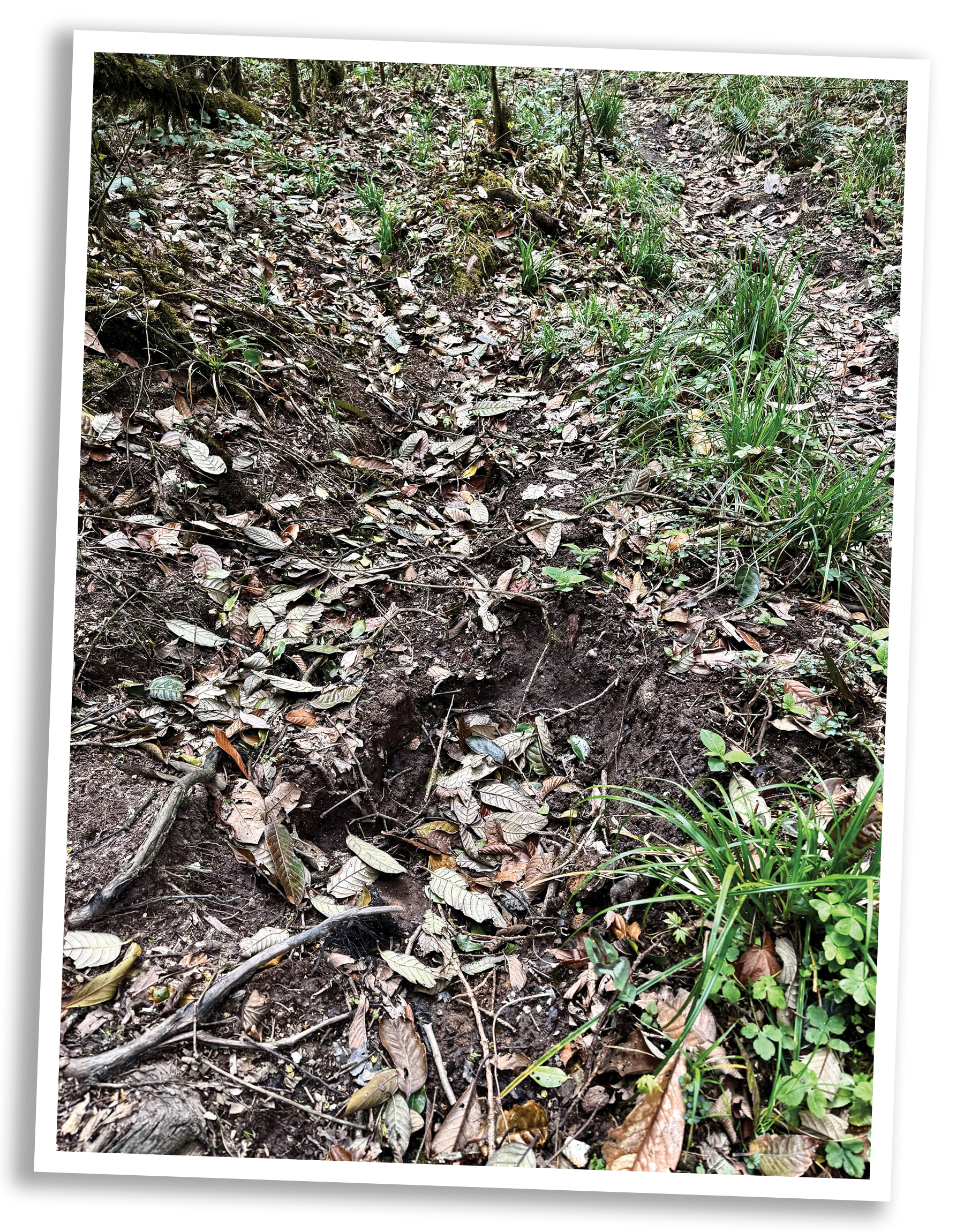
Fresh elephant footprints in Eaglenest Sanctuary. (Photo by Kim Frank)
Fresh elephant footprints in Eaglenest Sanctuary. (Photo by Kim Frank)
In disbelieve, I placed my hand in it, and then my own foot. I was literally walking in the footsteps of elephants at the highest elevation they have ever been recorded. I began to cry. Utterly enchanted, I pressed on. Now there was dung, lots of dung. And more prints. Here and there broken bamboo. Elephants had moved through this narrow path, eating as they went.
There was a small clearing at a false summit, not big enough for an elephant dance, but open enough for me to get my bearings. I breathed in the loamy smell of pinecones, mushrooms, decaying wood, unfurling ferns, spent flowers, fresh flowers and wet moss. I had not seen an elephant, but was walking in a myth made real. It was more than enough.
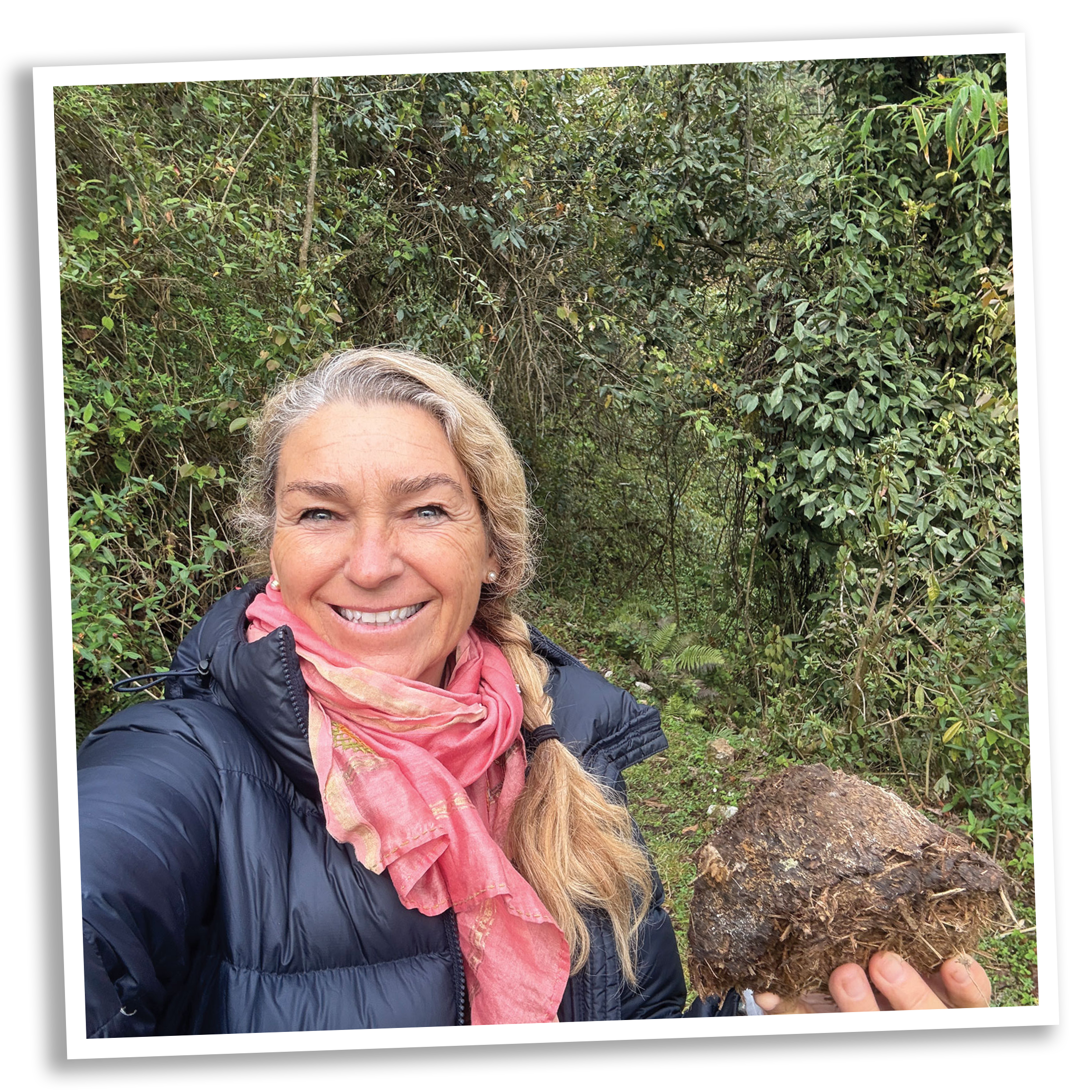
Finding elephant dung in a trail lifts Frank's spirits. (Photo by Kim Frank)
Finding elephant dung in a trail lifts Frank's spirits. (Photo by Kim Frank)
When I returned, flushed with exuberance, we ate lunch. I asked about the scarves and tiny temples in the trees. Our driver, a Buddhist, tells us that in 1959 the Dali Lama walked this exact trail as part of his escape route from Tibet into India. Buddhists pray there. The white scarves honor both his passage and the forest itself. The overlap of elephants and faith, of migration and escape, filled me with awe.
On the descent, everything appeared changed. Where I had seen only military sprawl and dirty streets, I now saw coexistence: indigenous traditions beside Buddhist devotion, warrior pride beside reverence for nature. I realized how quickly the lens of expectation can cloud our view — and how swiftly wonder can restore clarity. My quest had led me across elephant corridors, through stories of devotion and war and finally into a high-altitude forest where elephants still tread. What Kipling imagined in fairy tale still lingers in reality, if we are willing to look deeply enough.
Kim Frank is a writer, explorer and documentarian whose work focuses on human-elephant coexistence and the landscapes and cultures of the eastern Himalayas. She is a fellow of the Explorers Club and the Royal Geographical Society.