"Would you like to have a Patagonia moment?" our Chilean guide asks us, 40 minutes into our sentry duty at the base of the Pia Glacier in Tierra del Fuego: "Te invito a tener un momento de silencio?"
Twenty yapping voices are quieted in the vastness of this pinpoint at the edge of the earth. I hear a deep rumbling and cracking, like the timbers of a ship being crushed by ice, before a hunk breaks free from the mass to which it's been attached for the last 400 to 500 years and crashes into the frigid water to begin its cycle once again.
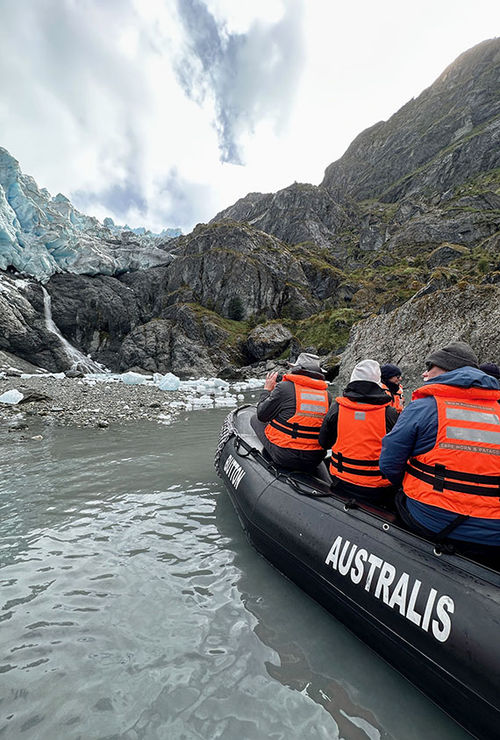
Zodiacs provide incredible access to glaciers in Tierra del Fuego’s narrow fjords. Photo Credit: Megan Padilla
Few people have witnessed this glacier calving because of its remote location in a fjord off the Beagle Channel near the farthest tip of South America. Access to one of the planet's most remote coastlines is what lures guests aboard Australis Cruises' Ventus and Stella.
The 200-passenger sister ships crisscross the southern fjords of Patagonia between the Chilean port of Punta Arenas and Argentina's Ushuaia on four-night trips that run nonstop September to April, during the South American summer.
The only way to see this dramatic and desolate scenery carved by ice is by boat, through the same passageways famously charted in the age of exploration. Australis has been dedicated to this route since 1990. For most guests, it is a one-way leg in a broader journey, whether as part of a South American tour package or a custom itinerary crafted by a travel advisor.
Since I'd be flying 27 hours, from Minneapolis through the Chilean capital of Santiago to Punta Arenas, to experience an Australis cruise, I opted for a roundtrip that would take nine days.
I arrived a day early for the cruise, and was glad I did: The Hotel Cabo de Hornos turned out to be perfect for a reset: modern, comfortable, located on the Plaza de Armas and walking distance from the port. They also welcome returning guests with luggage storage and lounge access before airport transfers.
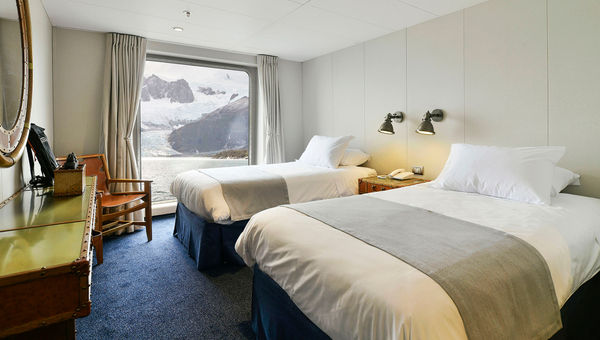
An AA Twin cabin. There are 100 cabins in six categories on the Ventus and the Stella, and each cabin has a large window. Photo Credit: Courtesy of Australis
A different sort of connection
I expected to see spectacular end-of-the-earth land- and seascapes. What I didn't expect was to feel so restored -- by nature, the effects of slow travel and having no cell or WiFi service (not even available for purchase). Australis' choice to limit its Starlink use to the crew sets an intention for the entire voyage: be in the moment.
Due to Patagonia's complex tides and mercurial weather that can cover every season in an hour, the expedition crew never shared more than half a day's plan.
It doesn't take long for me to let go of my need to know everything. When invited to a meal, I head down to the dining room. When summoned to a briefing, I go up to the Darwin Lounge to learn about our next excursion. In between, I nap, read or watch for whales, sea lions and dolphins from the large window in my cabin or from any of the three panoramic lounges. When the bird-watcher with the long camera lens rushes out to the deck, so do I.
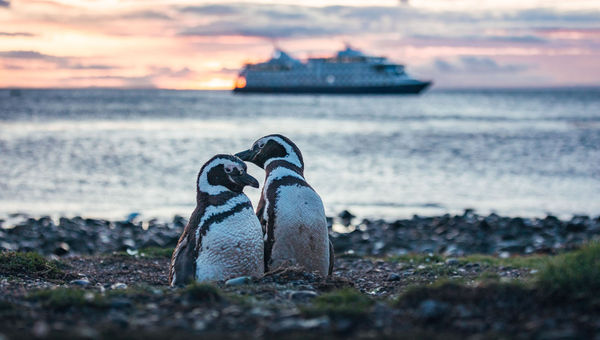
Nesting Magellanic penguins on Magdalena Island. Photo Credit: Courtesy of Australis/Florian Grieger
Small-ship expedition cruises can go where larger ships can't. In nine days I spot a total of five other vessels. Two are sailboats, and one is our sister ship. Instead of docking at ports for excursions, guests load onto Zodiacs to be ferried to shore for hikes or go on a nature cruise for close-up viewing of glaciers, nesting seabirds, sea lions and penguins. The excursions are the highlight of each day, and the Australis expedition team's passion and knowledge are equally matched.
Every Zodiac excursion begins by mustering in a lounge. Guests sort themselves into Spanish and English groups; the passenger manifest represents all 11 nationalities of the explorers who mapped the south part of Fireland (Tierra del Fuego) from 1520 to 1970: Portugal, Spain, England, the Netherlands, France, the U.S., Italy, Argentina, Austria, Germany and New Zealand. Guests arrive in head-to-toe layers, bulky orange life jackets buckled over the top, armored for adventure.
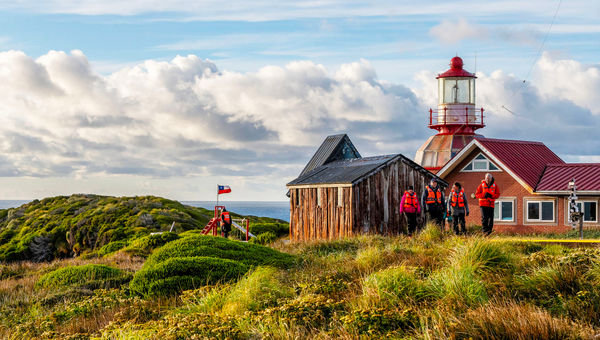
The Cape Horn lighthouse. The captain and crew make every effort for a landing at the legendary spot. Photo Credit: Courtesy of Australis
Calling on Cape Horn
Though the roundtrip covers the same route, it looks different in reverse. A few excursions are repeated, including a second chance to land at Cape Horn; at the northern edge of the Drake Passage, Cape Horn is one of the world's most notorious shipwreck graveyards.
For many passengers, this is the "life list" item they've come to check off. The captain and crew study weather and conditions and do everything possible to arrive in a window of possibility.
I am lucky to land both times, climbing the 200 steps to the boardwalks leading to a monument and a lighthouse. I even meet the light keeper and his young daughter and son, who sell watercolor paintings and other souvenirs.
During both visits, the captain calls us back to the ship by horn because the weather is taking a dramatic turn.
We return to the ship chilled, damp and dirty but ebullient and chatty with the camaraderie of a shared experience.
Folks drift off to their cabins to shed gear, then dribble back into the Darwin Lounge, the top-deck perch encircled entirely by windows and with a well-stocked, complimentary bar at its center. Blenders whir, shakers shake, ice clinks, drinks emerge in all shades and glass shapes.
No one asks what time it is, not even those who typically abstain from day drinking. In Patagonia, we are all living in the moment.
UPDATED: This report was updated on July 14 to include information about the author's overnight stay at the Hotel Cabo de Hornos prior to the sailing.