
Experience in making travel accessible
Three advisors rely on lessons learned in their own travels to create smooth journeys for clients with accessibility needs.


Evan Harris, a travel advisor from Texas, used the analogy of a sound-mixing board to describe his state of being “every second of every day.”
“Imagine a big board with all these switches and faders — some for each of the five senses, maybe a sixth sense, and then a bunch of others for senses and such that science doesn’t even have names for yet,” he said. “Now turn each of those switches on, push all the faders up to 13 out of 10 and glue them all stuck in those positions.”
Harris is autistic and has ADHD. He knows what it’s like to be in that state while having to navigate a busy airport, where jet engines are roaring and he’s surrounded by a crush of strangers.
But he doesn’t want that to stop other neurodivergent people from getting out and seeing the world, and he is dedicated to using his own travel experiences to help them.
“I think we’re all aware of the sentiment of ‘see a need, fill a need,’” he said. “I picked a pretty good need to meet.”
Harris is not alone in letting his lived experience inform how he works with clients as a travel advisor.
While the allure of travel appeals to many, for would-be tourists with certain needs — from mobility to life-threatening allergies — navigating the globe can seem impossibly challenging.
But like many problems encountered in travel, advisors have solutions, some that are rooted in their life experiences. They stand ready to serve specific groups of clients with expertise gained on the ground during their own travels.
What follows are the stories of three advisors who are working to make travel more accessible to all. The advisors are Harris, who along with his mother, Linda, are focused on serving neurodivergent clients; a wheelchair user in Canada helping clients with mobility needs; and a food allergy specialist in North Carolina with some 30 allergies or intolerances of her own.

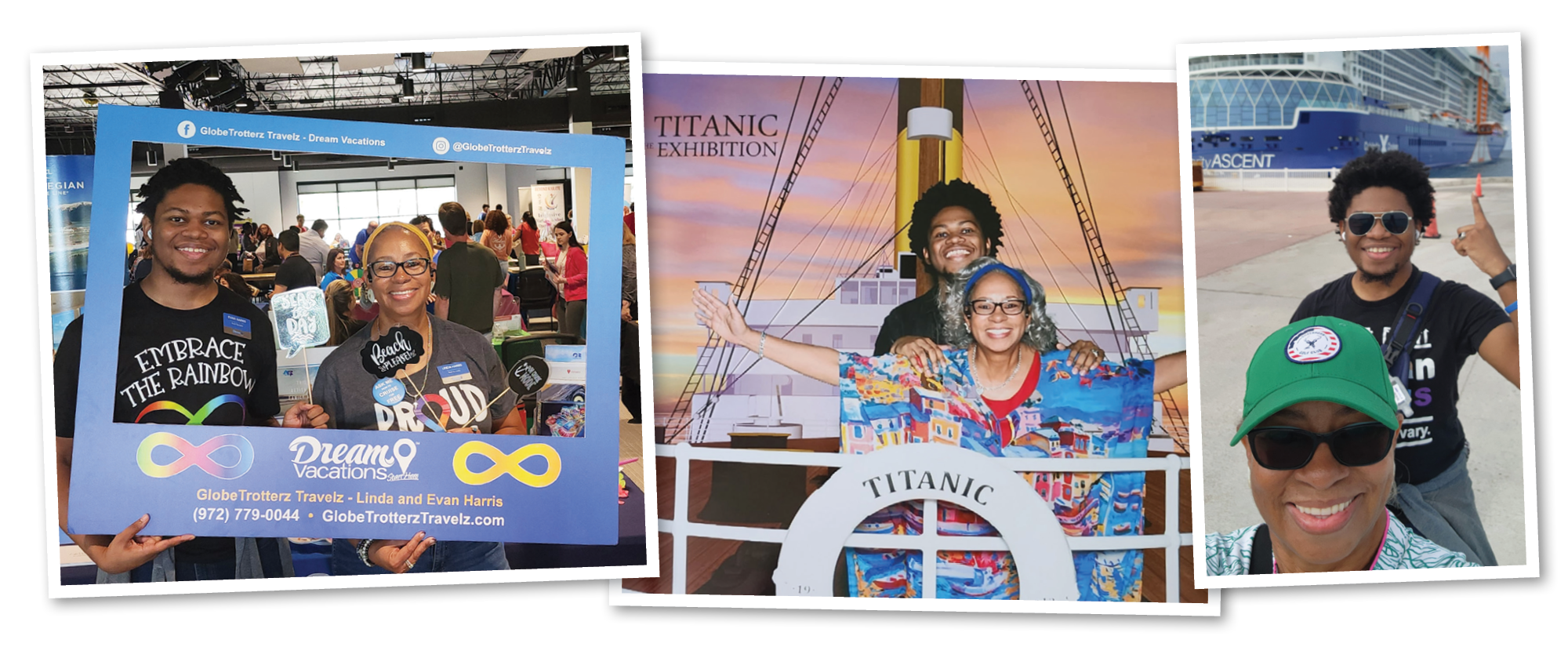
Far left, mother-son duo Linda and Evan Harris run a Dream Vacations franchise in DeSoto, Texas. Evan is autistic and has ADHD. Middle, GlobeTrotterz Travelz brings together Evan’s skills as a “walking encyclopedia” with Linda’s “beyond razor-sharp logistical prowess.” Left, the Harrises, shown here with the Celebrity Ascent, share a love of cruising. (Courtesy of Evan Harris)
Far left, mother-son duo Linda and Evan Harris run a Dream Vacations franchise in DeSoto, Texas. Evan is autistic and has ADHD. Middle, GlobeTrotterz Travelz brings together Evan’s skills as a “walking encyclopedia” with Linda’s “beyond razor-sharp logistical prowess.” Left, the Harrises, shown here with the Celebrity Ascent, share a love of cruising. (Courtesy of Evan Harris)
Neurodiverse globe-trotters
The Harrises opened a Dream Vacations franchise, GlobeTrotterz Travelz, in DeSoto, Texas, in September 2024. They’ve both always loved cruising, so when Linda decided to transition into the travel industry from a career in education, Evan agreed to join her as her partner.
He had an early interest in design and architecture and a special interest in the Titanic. After graduating at the top of his class in high school, Evan went on to college to study architecture, but the school system was “ill-equipped to help nurture different minds like mine,” he said, “and you take a hint after a while.”
Working at a travel agency, though, seemed like a natural fit.
Evan said that pairing his skills “as a walking encyclopedia, as I’ve been called throughout my life,” a historian and Titanic aficionado with his mom’s “understanding of the neurotypical world” and her “beyond razor-sharp logistical prowess, and there goes your dream team right there.”
For her part, Linda wanted to be sure to “include the autistic community, the neurodivergent community, and to really make sure that they have a voice in this industry.”
Evan said his goal is to prepare his neurodivergent clients in advance for travel experiences like being on an airplane, in an airport or on a cruise ship. While some companies have taken steps to better serve the neurodivergent community (Linda pointed to special lanyards that identify autistic people, for example), many don’t, so Evan shares strategies that have worked for him while waiting for the world to catch up.
That the industry is looking to meet neurodivergent needs is a step in the right direction, he said. No one was doing that when he was a young traveler.
“It’s already met the better-for-my-kids threshold, and basically, I just want it even better,” he said.
Linda strives to share the message that travel is possible for families with neurodivergent members.
“You can get out there, and you can enjoy life,” she said. “And that’s our goal. That’s our mission.”
During Dream Vacations’ conference last year, the Harrises met with its leadership, including senior vice president and general manager Drew Daly. Daly was so impressed with their mission that he spoke about Evan on stage during the event.
“He’s doing what he’s doing because he wants to make sure that people with autism have a place at the table to travel,” Daly said. “To enjoy those experiences and to make a difference.”
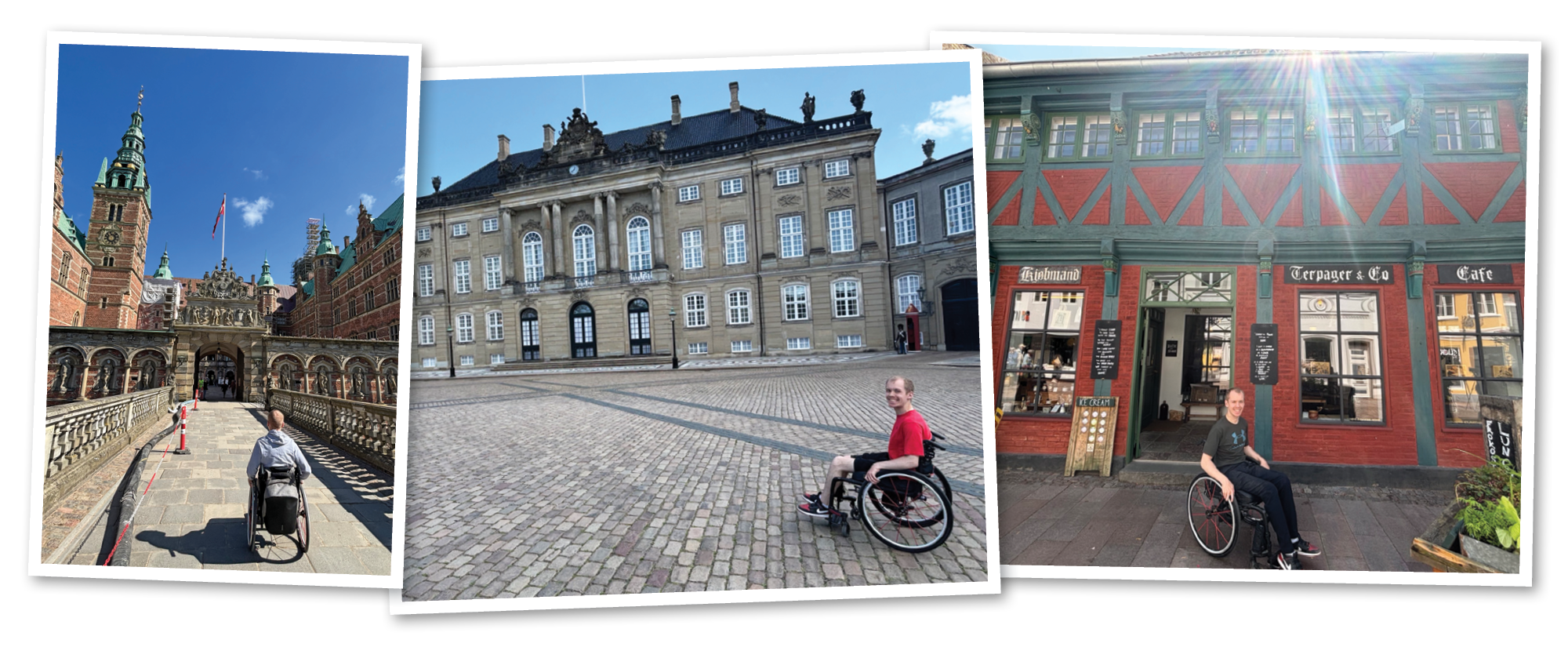
Far left, advisor Josh Holton at Frederiksborg Castle in Hillerod, Denmark. He specializes in accessible travel with Departures Travel Sidney in British Columbia. Middle, Holton at Amalienborg in Copenhagen. Left, Holton in Ribe, Denmark. Holton, who has cerebral palsy, hopes to compete for Denmark in the 2028 Paralympic Games. (Courtesy of Josh Holton)
Far left, advisor Josh Holton at Frederiksborg Castle in Hillerod, Denmark. He specializes in accessible travel with Departures Travel Sidney in British Columbia. Middle, Holton at Amalienborg in Copenhagen. Left, Holton in Ribe, Denmark. Holton, who has cerebral palsy, hopes to compete for Denmark in the 2028 Paralympic Games. (Courtesy of Josh Holton)
Accessibility gold standard
It’s no surprise that wheelchair rugby was originally called murderball: Travel advisor Josh Holton describes the full-contact sport for wheelchair users as “high-action bumper cars.”
Holton, who has cerebral palsy and uses a wheelchair, started playing the game when he was 16 and was selected to join the Danish National Development Team in preparation for a possible spot in the 2028 Paralympic Games in Los Angeles.
But Holton isn’t just an athlete. As a travel advisor with Departures Travel Sidney in British Columbia, he specializes in helping other wheelchair users navigate the world informed by his own experiences traveling everywhere from Hawaii to Europe.
“A lot of people in wheelchairs that I came across, they have nowhere to go — or know who to talk to — about accessible travel,” Holton said. “That kind of popped off in my head, like, ‘Oh, if I can help out in that way, maybe I can make their time a little easier, and I can handle all the other logistics.’”
Holton has been an advisor for a year and a half. When working with clients who have mobility needs, he begins by assessing their needs. He asks about things like the kind of wheelchair they use (electric or manual), whether they can walk some distances and if they need ramps. He likened it to doing his homework.
Then he contacts suppliers to make the necessary arrangements.
“Usually they’re pretty helpful, but there are [situations] I’ve run into where clients have gotten to the hotel and [it] gave up the accessible room to somebody else even though I booked it,” he said. “That can be very, very hard.”
At that point, he said, he contacts other nearby hotels to find an available accessible room.
Departures Travel is a member of Ensemble, and Holton and co-owner Cathy Larsen, who is also Holton’s aunt, traveled together to one of its recent conferences. She called it eye-opening to see each step a wheelchair user needs to go through to travel, including the amount of time it takes to get on and off a plane.
“Those are really things that Josh has to take into consideration [with clients],” she said. “He knows that, because he lives that life.”
Larsen is supportive of Holton’s current goal: representing Denmark, where his grandparents are from, in the 2028 Paralympics in wheelchair rugby. It’s a dream of his since childhood, for which he trains six times a week and will temporarily relocate to Denmark in January.
“I’m working my way,” he said. “I’ve still got three years, and hopefully, L.A. will be calling my name and we’ll be headed there. But I’ve always wanted to be part of that.”
He and Larsen are used to staying in touch when he’s abroad, keeping a dialogue going around work and clients.
“It’s wonderful to see this opportunity, and to see him flourishing is just amazing,” she said.
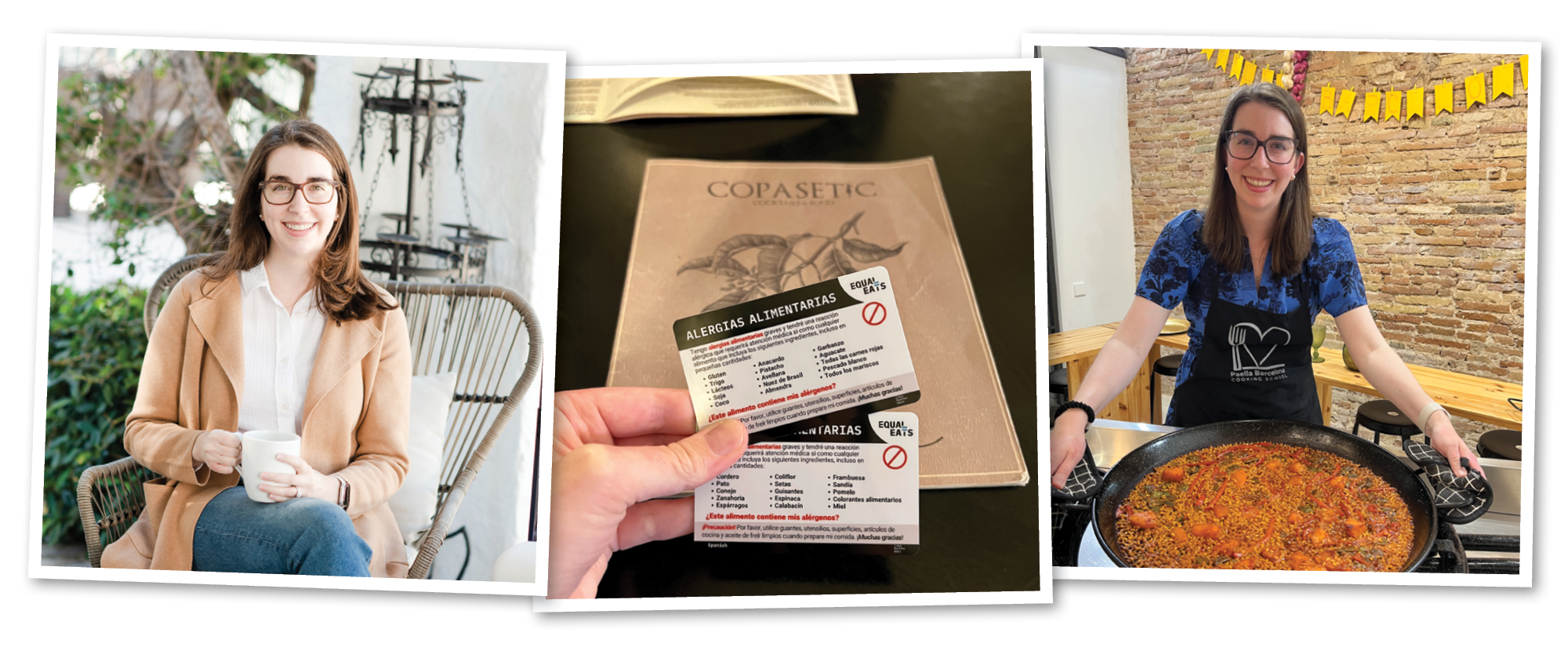
Far left, Lauren Scheffer, who has around 30 food allergies and intolerances, started Food Allergy Getaways. Middle, Scheffer gives clients food allergy cards to take on their trips. One side is in English and the other is in the language of their destination. Left, Scheffer, who carries her own allergy card when she travels, in Barcelona. (Courtesy of Lauren Scheffer)
Far left, Lauren Scheffer, who has around 30 food allergies and intolerances, started Food Allergy Getaways. Middle, Scheffer gives clients food allergy cards to take on their trips. One side is in English and the other is in the language of their destination. Left, Scheffer, who carries her own allergy card when she travels, in Barcelona. (Courtesy of Lauren Scheffer)
Allergy-free itineraries
Lauren Scheffer, the owner of Food Allergy Getaways, walks the walk when it comes to traveling with food allergies: She has around 30 food allergies and intolerances.
“It’s a double-edged sword, unfortunately,” said Scheffer, who is based just outside Charlotte. “I don’t wish that I had this many, but it’s definitely given me an understanding and an ability to connect with people.”
Scheffer was diagnosed with food allergies when she was in college. After graduation, when she began traveling to conferences for her marketing job, she started blogging about traveling with food allergies.
It resonated. People started to reach out to ask for her help. She began consulting, then realized she could turn it into a full-time travel business serving families with food allergies. (She also works with clients with dietary preferences, like vegetarians and vegans.)
Today, Scheffer specializes in land trips to Europe. She also offers a restaurant research service, where she will reach out to restaurants to inquire about their menus and protocols related to food allergies. Acceptable locations are denoted on Google Maps, as are grocery stores and local hospitals.
When she starts working with a client, Scheffer digs into their food allergies and comfort levels about a variety of things. For instance, can their allergies be accommodated by a hotel, or should she find them accommodations with a kitchenette if they need to pick up safe food and prepare it themselves? When it comes to daytrips and other activities, are there restaurants that can accommodate them?
“Basically, the whole trip is looked at through the lens of, how can we do this with your food allergies, and how does that play into it?” she said. “And then also, ultimately, what does it look like for emergencies? Hospital visits, getting travel insurance, pre-existing conditions, waivers with travel insurance — it is a full service.”
Traveling with food allergies has gotten easier over the years as more countries are getting better about labeling, she said, but it’s still not without risks. And she requires clients to sign waivers.
“Anytime someone leaves their home with food allergies, there is a risk,” she said.
She also provides clients with food allergy cards listing their allergens prior to their trip. One side is in English and the other is in the language of their destination. Scheffer carries her own when she travels and hands them to waiters. They’re also helpful in grocery stores to identify the names of allergens on food labels.
Oftentimes, clients come to Scheffer with ideas of where they’d like to go. Depending on their allergies, she sometimes tries to steer them differently. For instance, while Paris is a popular destination, it’s not the best for those with peanut allergies as peanut oil is often used to fry food. Another country might be more accommodating.
“A big part is just managing expectations, helping people to understand what the experience will be like and what kind of trip they’re ultimately looking for,” she said. “Because at the end of the day, you’re spending a lot of money to travel, and you want to have a good time.”