The Dominican Republic, long a top Caribbean destination known for its value-oriented all-inclusive resorts, is in the midst of a luxury room boom, with nearly 15,000 new accommodations expected over the next three years, many in the upscale segment.

Michael Cummings
The roughly 18% increase in room inventory is skewed toward the higher end of the market, said Michael Cummings, managing director for valuation and advisory services at CBRE.
"The luxury segment is continuing to increase, with more than 1,000 upscale rooms set to open just in Miches this year," Cummings said.
Miches, a relatively new tourism area located roughly 60 miles west of Punta Cana, has seen significant investment. Secrets, Dreams and Zemi all-inclusives debuted in Miches earlier this year, each with 500 guestrooms. A Four Seasons luxury resort and residential complex spanning 60 acres along Playa Esmeralda is slated to open in 2027.
At the same time, the Dominican Republic's flagship destination, Punta Cana, is experiencing its own upscale push. Earlier this year, Punta Cana welcomed the 200-room St. Regis Cap Cana and the 340-room W Punta Cana, the W Hotels brand's first all-inclusive.
Next year will bring the opening of Moon Palace The Grand Punta Cana, a $1.5 billion luxury all-inclusive project with two 18-story towers and 2,171 rooms. Daniel Adolfo Conte, vice president of commercial relations at The Palace Company, said the Moon Palace will be the D.R.'s largest single resort by room count.
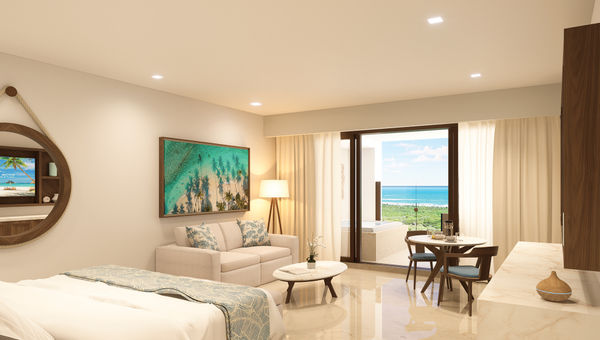
A rendering of a king guestroom at Moon Palace The Grand Punta Cana. Photo Credit: The Palace Company
"Our [plan] is to bring a complementary demand into the island," Conte said. "And bringing people who are used to properties like ours in Cancun -- and that same level of service and ADR as well -- to Punta Cana." (Starting rates at Moon Palace The Grand Cancun hover around $700-$1000 per night.)
Conte acknowledged, however, that delivering on luxury service at that scale will require significant workforce investment. The Palace Company is in the process of recruiting employees and is also implementing a comprehensive training program. It is sending around 300 staff from Cancun to work in Punta Cana and roughly 500 staff from the Dominican Republic to Mexico to work and train before the opening.
"We really need to make sure we have the standard of services we are offering in Cancun, and this is the best way to do it," Conte said.
The project also calls for the building of the Ciudad Palace for hospitality workers, with 1,800 apartments, schools, a hospital and other facilities that will eventually house and serve more than 12,000 people.
"One of the biggest issues in Punta Cana right now is that [resort workers have to] travel hours to get to work and then hours to go back, or sometimes they need to live far from their families," Conte said. "We are going to give people the chance to live with their families very close to the property."
Other brands are also planning premium expansion in Punta Cana.

Simon Suarez
Nobu Hotels has announced plans to open the 200-room Nobu Hotel Punta Cana, while Palladium Hotel Group is adding to its existing resort complex in Punta Cana with the debut in December of two all-inclusive concepts: the Grand Palladium Select Bavaro and the Family Selection at Grand Palladium Select Bavaro.
Simon Suarez, vice president of Grupo Puntacana and a director emeritus on the Caribbean Hotel and Tourism Association's executive committee, credited government investment in new areas of the country on infrastructure, including roadways, water, sewer and electricity. "All the elements that are important," he said.
Signs of hotel softness
Despite the expansion, hotel performance metrics have shown some softness, even as the D.R.'s 5 million international visitor arrivals from January through August was up roughly 1% year over year.
The country's hotel and tourism association reported average hotel occupancy of 77.7% for January through August 2025, down 1.5 percentage points from the same period in 2024. August occupancy of 69.5% was down 3.7 points year over year.
CoStar data showed September occupancy had dipped to 49.3% from 53.4% the prior year, and average daily rate (ADR) declined 5.5%, to $167.92. While Jan Freitag, national director of hospitality analytics for CoStar Group, characterized the decline as a potential blip related to calendar shifts, he also said D.R. occupancy had declined for five consecutive months through August, with ADR remaining flat at about $220.
Freitag pointed to cruise competition as a potential factor.
"If you look at cruise performance in terms of passenger volume and increases in rate, they have done phenomenally well," he said. "And I think there's probably a siphoning off of the leisure, value-oriented traveler from hotel stay to cruise."