The coming year will bring a spate of construction project completions and major milestones at large U.S. airports.
Southwest, JetBlue and Frontier will introduce premium cabin products as they continue chasing the successes of Delta and United.
Alaska Airlines will move into the late stages of its integration of Hawaiian Airlines.
Spirit Airlines might operate its final flights.
And agentic AI will be the latest big thing in air travel bookings.
Airport upgrades
For airports, said Brad Beakley, CEO of travel industry consultancy Hospitio, "It should be a pretty exciting 2026."
He pointed to New York JFK, where the first gates in the $9.5 billion international New Terminal 1 are slated to open, as well as the first gates of the $4.2 billion redevelopment of Terminal 6.
At Houston Bush Intercontinental, the $2.5 billion transformation of Terminal B, financed by United, is slated for completion next fall. It includes 22 new gates and 18 gate renovations.
At LAX, where a $30 billion capital improvement program is underway, an anticipated 2026 milestone is the completion of the $3.3 billion, 2.25-mile, automated people mover.
And Beakley also noted that Dallas-Fort Worth's $2.7 billion Terminal A Pier Expansion, undertaken in partnership with American Airlines, is scheduled for completion in 2026. The project includes five new gates and five gate rebuilds.
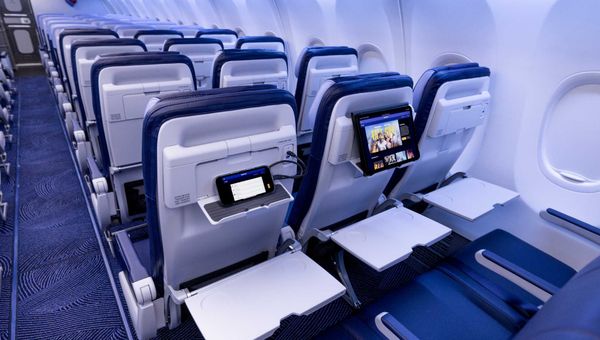
Southwest Airlines' new cabin features power at every seat and seatback holders for personal electronic devices. Photo Credit: Southwest Airlines
Class-y adjustments
On the airlines front for next year, Southwest flyers will at long last sit in reserved seats, including extra legroom seats, beginning Jan. 27.
JetBlue, meanwhile, plans to introduce domestic first-class cabins in 2026. Frontier expects to debut its first-class-style seat, which will be similar to Spirit's Big Front Seat, in early 2026. But a broad rollout of the product will ensue early next year.
The moves by Southwest, JetBlue and Frontier will continue their efforts to make a dent in the dominant U.S. airlines profit margin positions held by Delta and United, which have captured more than their share of the outsize premium airline demand that emerged after the pandemic. Those carriers, along with American and Alaska, will continue transforming their own aircraft in 2026 with a higher share of premium cabin seats, especially on widebody aircraft. For example, Delta president Glen Hauenstein said in October that most or all of the airline's 2026 growth will be in premium sectors, where revenue next year will surpass main cabin revenue for the first time.
Mergers and struggles
Alaska will be in the late stages of integrating the Hawaiian Airlines brand. The combination is enabling Alaska to branch out in competition with Delta on long-haul routes from Seattle and to go after Southwest's dominance in San Diego, where its flying will be up 35% year over year next spring.
"It seems like a stronger and bigger Alaska gives Southwest a little bit more of a run for their money along the West Coast," Beakley said.
The year will be especially vital for Spirit. The discount carrier, amid its second bankruptcy reorganization in less than a year, faces the prospect of liquidation, absent a sharp and swift turnaround.
As of Sept. 30, Spirit had liquidity of $250.5 million, having sustained third-quarter operating losses of $135 million.
The airline hopes to stem the bleeding with steep network cuts and the return to lessors of more than half its fleet, plus it bolstered its cash position in October with an infusion of $475 million from existing bondholders. Still, those steps might not be enough to keep Spirit solvent.
Agentic advancements
Elsewhere, the world of airline bookings and distribution could be in for a jolt in 2026 and beyond with the spread of agentic AI, in which virtual AI agents are able to perform tasks. The technology, for now still in its infancy, can complete bookings for travelers and also service those bookings. As such, it has the potential to upend business models and both assist and threaten traditional travel advisors.
"The adoption curve is going to be steeper in my view than it was for e-commerce," Vik Krishnan, an aviation-focused partner for the consulting firm McKinsey & Co., said on episode of Travel Weekly's The Folo podcast.