
AGENTIC AI TURNS SEARCHES TO SALES
New tools can complete bookings and even suggest itineraries according to traveler interests — challenging traditional models.


AGENTIC AI TURNS SEARCHES TO SALES
New tools can complete bookings and even suggest itineraries according to traveler interests — challenging traditional models.


In mid-October, I had an AI agent complete a flight booking for me.
It was my first experience with what many experts believe will soon be the norm in booking as capabilities and implementations grow exponentially for agentic AI, the technology that pushes beyond the information gathering and content generating capabilities of generative AI by performing actual tasks.
On Perplexity Comet, an early leader in agentic AI, including for travel, I first conducted a flight search utilizing Perplexity’s GenAI capabilities to return search results in conversational form. Armed with that information, I asked the Comet agentic assistant to book the flight of my choice via Southwest.com, which I was already logged into on the Comet browser.
I watched as, step by step, the agent took the necessary actions to make a booking in my name. It selected my fare class, provided my personal details and chose the flight I had requested.
Per my request, the agent paused so that I could confirm that the booking met my specifications, and then it confirmed my purchase, using the credit card information housed within my Rapid Rewards account.
Moments later, Southwest sent me a confirmation email.

AI agents
Agentic AI holds the potential to transform the search, booking and servicing of airline reservations — and bookings within the travel sector more broadly. As that happens, the technology is poised to transform business models, creating both opportunities and pitfalls for industry stakeholders, including travel advisors.
“I think it is going to profoundly change things,” said Vik Krishnan, an aviation-focused partner for the consulting firm McKinsey & Co. and the co-author of the report “Remapping Travel with Agentic AI,” published this fall by McKinsey in partnership with Skift. “In just a matter of a few years, I suspect we are all going to think of it as very natural to book our travel through an agentic interface. It is probably one of the more pronounced changes that is going to occur in the aviation sector.”
Perplexity, which can be used through its webpage search engine or within the Comet browser, is one of several early agentic AI innovators in flight and travel search and booking. Large technology companies and brands, among them ChatGPT, Google and Hopper, are also developing or offering agentic capabilities for travel booking or servicing. A ChatGPT agent can search and filter flights, hotels and experiences and then book flights and other travel — although it has the user take over during sensitive steps, like payment, said OpenAI consumer communications lead Leah Seay Anise.
Google is moving slower. Its Project Mariner will deploy agentic agents for travel planning and booking, but thus far the service is only experimental and available to Google AI Ultra subscribers in the U.S.
Hopper, meanwhile, has focused its early agentic AI deployment on servicing with its Assist tool. Hopper customers receive an email when their flight has been disrupted, offering new options. They can then talk to Assist via voice or chat to process those options or to make alternative arrangements. Assist is offered by the travel app both direct to consumers and, since October, as a business-to-business solution that can be incorporated by other travel companies.
In a recent demonstration, I listened and watched as Jo Lai, Hopper’s head of AI solutions and customer experience, demonstrated the tool, showing the ease with which she was able to alter plans in a voice conversation to extend her time in London and rent a car after she missed a connection to Paris through Heathrow.
Lai said that Assist can handle thousands of transactions at once, meaning that Hopper customers don’t have wait times as they deal with travel disruptions.
Newer companies, like Perplexity, are early leaders in purposing agentic AI for travel bookings. One is SkyLink, which developed a tool specifically for corporate travel that can search, offer advice and book flights, hotels and more, all while incorporating user preferences and staying within a company’s travel policy, said co-founder Atyab Bhatti.
Bhatti said SkyLink offers far more than what can be accomplished using a traditional point-and-click corporate booking tool.
“It’s like talking to a person. And when you’re talking to a person, the person understands your tone,” he said, and will reason with the client based on that. “They understand the type of trip you are trying to take. They understand what your kind of incentives are. It can actually guide you to make a better decision.”
The tool, already in use by BCD and Amex GBT, tries to steer corporate travelers toward less expensive flights when possible, he added, saving money for companies.
“What SkyLink does is bring that human consultative experience into the traditional booking channels that we have today,” Bhatti said.
Meanwhile, other large players in flight and travel booking are gearing up for agentic AI.
Sabre announced last month that it has developed agentic solutions that will enable travel agencies to connect their AI systems with the Mosaic retailing platform to perform independent tasks such as rebooking and payments.
Then there’s Kayak, whose CEO, Steve Hafner, spoke of agentic AI as a potential existential threat to travel metasearch engines in an interview last April. Since that time, Kayak has begun developing its own agentic capabilities. In October, the brand launched its AI mode, partnering with ChatGPT to leverage Kayak data in a conversational chat box. With some suppliers, including Alaska Airlines, bookings can now be made through the supplier’s direct channel but without leaving the Kayak site.
“AI Mode has some agentic capabilities, and this launch takes us a step closer to realizing our full vision where Kayak can book, modify and manage travel in real time,” the company said.

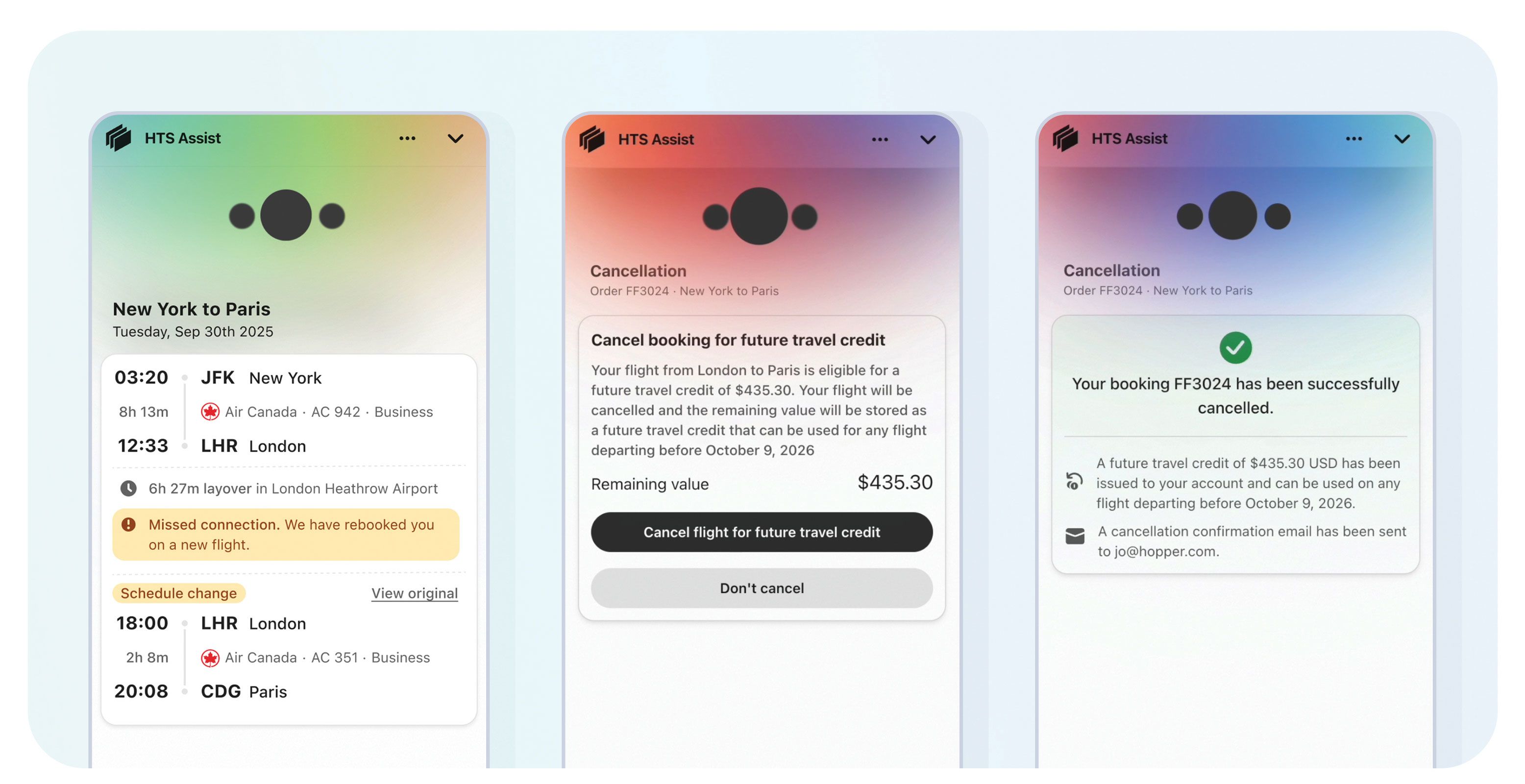
Hopper’s Assist tool uses agentic AI for rebookings and itinerary changes during travel disruptions. (Courtesy of Hopper)
Hopper’s Assist tool uses agentic AI for rebookings and itinerary changes during travel disruptions. (Courtesy of Hopper)
Growing personalization
When I had the Comet browser book that Southwest flight, it was what I would consider an entry-level agentic experience. Because I was new to the browser, the AI agent didn’t yet know my preferences and patterns, so it couldn’t suggest actions accordingly. But that should change with more use.
Perplexity deputy chief technology officer Jerry Ma said that a distinguishing feature of Comet is that it personalizes responses. And because Comet is a browser, it knows what its users do on the web and can learn about them faster than from the Perplexity search engine or other search engines.
The browser, said Ma, has a “super memory” on how to best serve users, including their preferences and interests. That includes users’ comfort level with agentic AI. Comet will take note of how often users hand off tasks to the AI agent and will adjust its actions accordingly.
Comet also integrates with personal calendars and can use that information to personalize itineraries.
In the “Remapping Travel with Agentic AI” report, the authors present a hypothetical example of a traveler named James to exemplify how agentic AI could revolutionize the travel-planning and booking process.
“While scrolling through social media, he might stop on a video of a Maldives resort,” they wrote. “His agentic AI travel assistant could recognize his interest, identify his prescheduled vacation days, remember his travel preferences, sort out his loyalty points and propose a complete, personalized itinerary, including flights, meals and excursions. James could ask for changes, and agentic would instantly rearrange the schedule. And then, with one tap, James could confirm the booking — no flipping through website tabs, no endless scenario mapping and no missed opportunities.”
GenAI, they note, could provide James with concise travel-planning assistance in response to one-off prompts. But agentic AI could go further than that, proactively offering travel suggestions and also readily making bookings and itinerary changes.
Ma said that for now, Perplexity’s AI agent is reactive only, responding to requests. But proactive capabilities are under development and could debut on Comet within months.
“You’re going to see agents start automatically triggering when they observe something that they see you’d like to do,” he said.
As an example, he depicted a scenario of a New Yorker who has show tickets and who typically commutes on the subway. Comet will notice when there is maintenance on the tracks and then notify the user to leave early and use an alternative route.
Sticking more specifically to the flight realm, Bhatti said that SkyLink doesn’t yet take proactive measures when a user’s flight is canceled. But that’s in the works.
“We want to be an end-to-end solution,” he said.

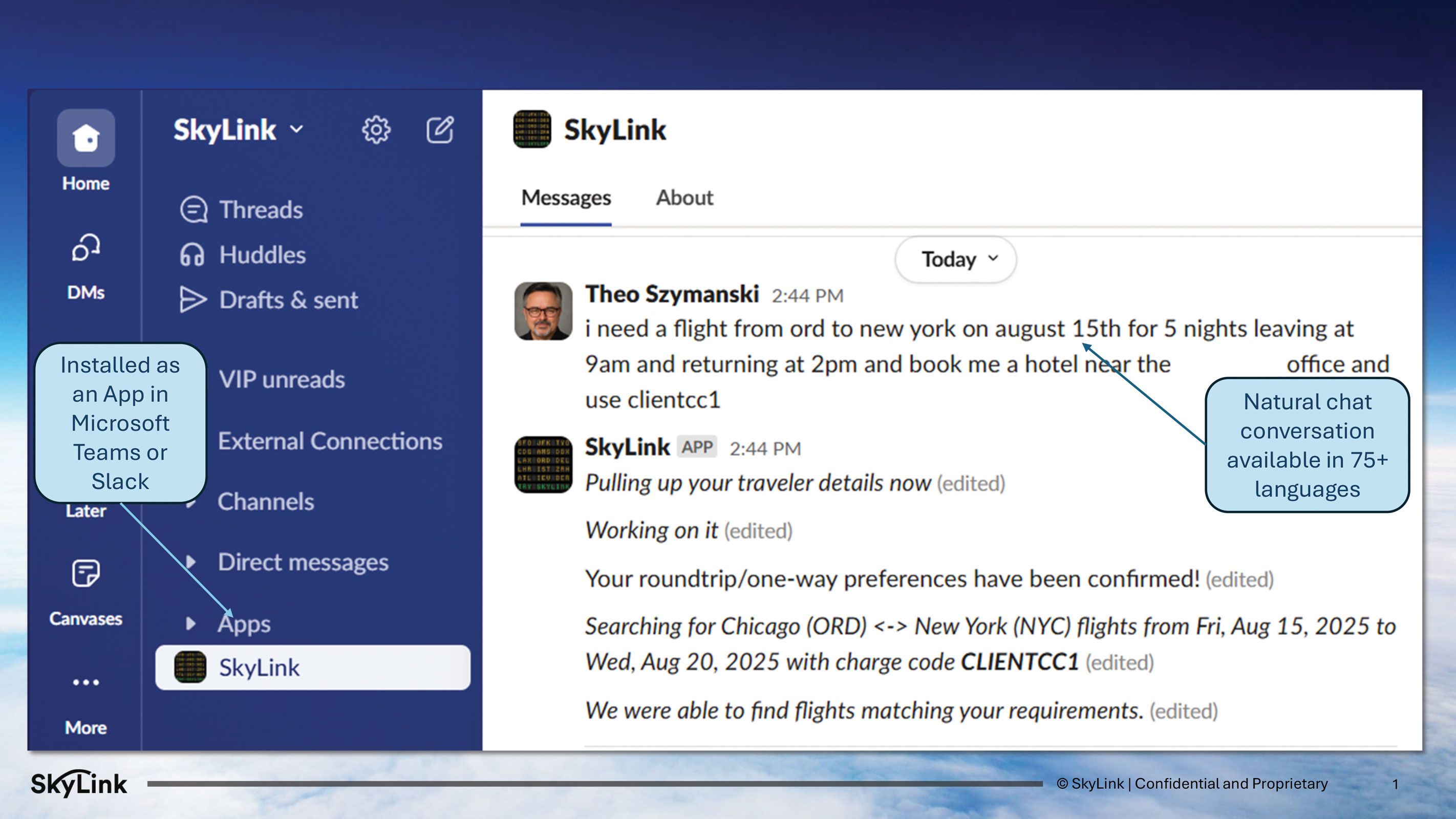
The SkyLink agentic tool communicates in conversational language and books travel while considering corporate policies and user preferences. (Courtesy of SkyLink)
The SkyLink agentic tool communicates in conversational language and books travel while considering corporate policies and user preferences. (Courtesy of SkyLink)
A threat to the OTAs ...
With a 24-hour presence and abilities to reason, accomplish tasks and act autonomously, agentic AI has the potential to assist, but also sharply disrupt, the flight and travel booking ecosystem.
One group of especially vulnerable parties are OTAs and metasearch sites. Historically they’ve relied on referrals, paid and organic, by Google and smaller search engines to generate business. But those business models could potentially be rendered moot by agentic booking platforms if the model becomes dominant and if those platforms transact directly with airlines and other travel suppliers.
Partnerships are one way to counter that threat. Expedia, for example, has partnered with Perplexity so that flight searches and bookings on the Comet browser are transacted through Expedia as a default, unless otherwise specified.
OTAs and metasearch sites can, of course, develop their own agentic agents if they have the resources, as Kayak is working on. But Kayak’s Hafner also spoke in the spring about the benefits that could come from a Kayak-ChatGPT partnership. In response to a travel query request, ChatGPT’s agentic agent could scour dozens of suppliers on the web, he said. Or it could partner with a resource like Kayak, which already has connections with those suppliers.
“We’re a single source for travel information. It’s a lot more efficient and commercially monetizable for the AI to go to us,” Hafner said. “And then, when there’s an actual booking or a change in travel plans, again, we have those connections with all those airlines and other travel partners and OTAs, so the AI can come to us.”


‘You can see a world where no AI agent can displace someone who has privileged access.’
... and to advisors?
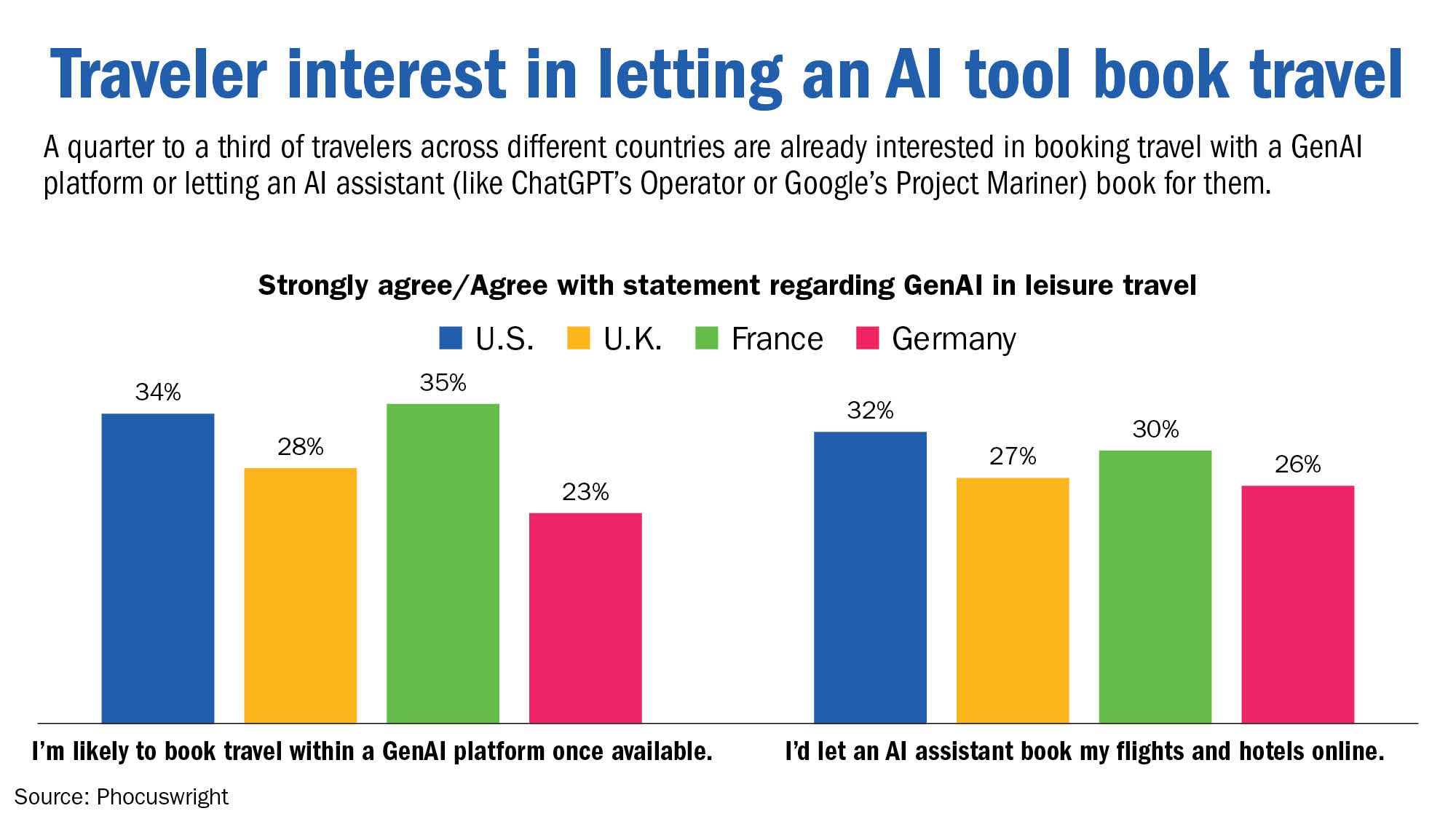
Agentic agents could also pose a threat to human travel advisors. In a survey fielded in April by Phocuswright, 32% of U.S. respondents said they’d let an AI assistant book their flights or hotels online, a number almost certain to increase with time. McKinsey’s Krishnan predicts the adoption curve for booking agentic travel will be more rapid than adoption was for using search engines a generation ago.
There’s potential, Krishnan said, for the transition to create upheaval for traditional travel agencies, though that bell has been tolled often in the past.
“The death of brick-and-mortar travel agents has been foretold for a long time,” he said. “What has kept them around is a highly curated or specialized service offering.”
For example, Krishnan said, many traditional travel agencies have shifted to specializing in ultrahigh-end experiences with scarce inventory in partnership with selected suppliers.
“You can see a world where no AI agent can displace someone who has privileged access,” he said.
Purveyors of agentic AI say the technology can be a tool for leisure travel agencies and TMCs.
Hopper’s Lai said that for post booking, the company’s Assist solution can remove repetitive tasks from advisor workloads, helping to keep their service consistent.
“We really do see this as advisors using this in tandem with their clients, rather than a zero-sum game,” she said.
Bhatti said SkyLink’s agentic AI capabilities could potentially be used to replace some human staffing needs at TMCs. If they choose to maintain staffing levels, they could increase their service offering.
“We are seeing these agentic workflows really drive an astronomical amount of efficiency because now you have pseudo-employees, digital employees that can 24/7 work on this,” he said. But he added that human advisors will always be needed to perform complicated tasks and provide the human touch.
“Agentic will have its place, but I don’t think it will ever be able to replace the individual,” Bhatti said. “Travel is a deeply personal experience, and agents will always be there.”