
A devotion
to faith-based travel
As the Israel-Hamas war drags on, tour operators that normally focus on the Holy Land have discovered there’s an appetite for similar itineraries in other parts of the world.


A devotion
to faith-based travel
As the Israel-Hamas war drags on, tour operators that normally focus on the Holy Land have discovered there’s an appetite for similar itineraries in other parts of the world.


When it became clear that the war that broke out in October 2023 between Israel and Hamas wouldn’t be a short-lived conflict, Sue and Russ Goodman knew they had to pivot business operations to survive.
The Georgia couple owns Faith Based Expeditions, a tour operator for which trips to the Holy Land were its bread and butter, accounting for 90% of business. Over the last two years, as Israel’s tourism has wilted due to the ongoing war, faith-based tour operators like the Goodmans have been forced to rethink their approach to the travel niche.
For Faith Based Expeditions, the required shift revealed a silver lining: a crop of new destinations outside of Israel to support the business and a long-term strategy to manage operations when conflicts arise. Now, the operator offers faith-based itineraries to countries like Germany, Great Britain, Ireland and Egypt.
“You get complacent after a while,” Russ Goodman said, adding, “We have brand new marketing of countries that we didn’t have before. ”
And while operators like Faith Based Expeditions are hopeful that the October ceasefire agreed to by Israel and Hamas will stick, enabling them to resume regular departures to the region, their portfolios of faith-based tour destinations have grown.
They are not alone. Over the last two years, tour operators in the faith-based niche have pivoted marketing efforts and operating itineraries to other sites that hold significance for travelers of faith, and were rewarded with compelling options.
David Welch, vice president of business development for ETS Tours, one of the largest faith-based tour providers, said that as the war continued, both ETS and its counterparts in the niche started saying, “OK, where else? What else are people hungry to do? What’s on their bucket list, and how can we start chipping away at those? How can we do a better job at making them aware that these options are available to them?’”
One Mediterranean country, in particular, has exploded in popularity for ETS.
“Greece is just bonkers,” Welch said. “Normally for our programs, we offer the land tour and we also offer the cruise add-on. Well, [the cruises] are selling out, and it can be disappointing when people don’t buy fast enough.”
One of the operator’s most popular trips is the Journeys of Paul in Greece & Turkiye itinerary, which brings the Christian faith to life by visiting locations where believers say the Apostle Paul preached. In Turkiye, travelers discover where Paul is said to have led missionary work.
ETS has also observed the religious rise of Britain and Ireland, which Welch said has “done exceptionally well over the last few months, almost as much as Greece.” Itineraries explore the U.K. and Ireland, where travelers walk in the steps of Christian author C.S. Lewis and can explore Celtic Christianity in Scotland.
Though faith is the focus of such a trip, it’s not all religion all the time. The itineraries also prominently feature local history and culture.
For instance, the Legacy of Nelson Mandela in South Africa tour from ETS focuses on the activist and first president of South Africa who was imprisoned for his efforts to abolish the country’s apartheid laws. On the 12-day itinerary, when travelers aren’t on safari or exploring Cape Town, they visit local Christian and Catholic churches and attend a talk on social justice led by local clergy.

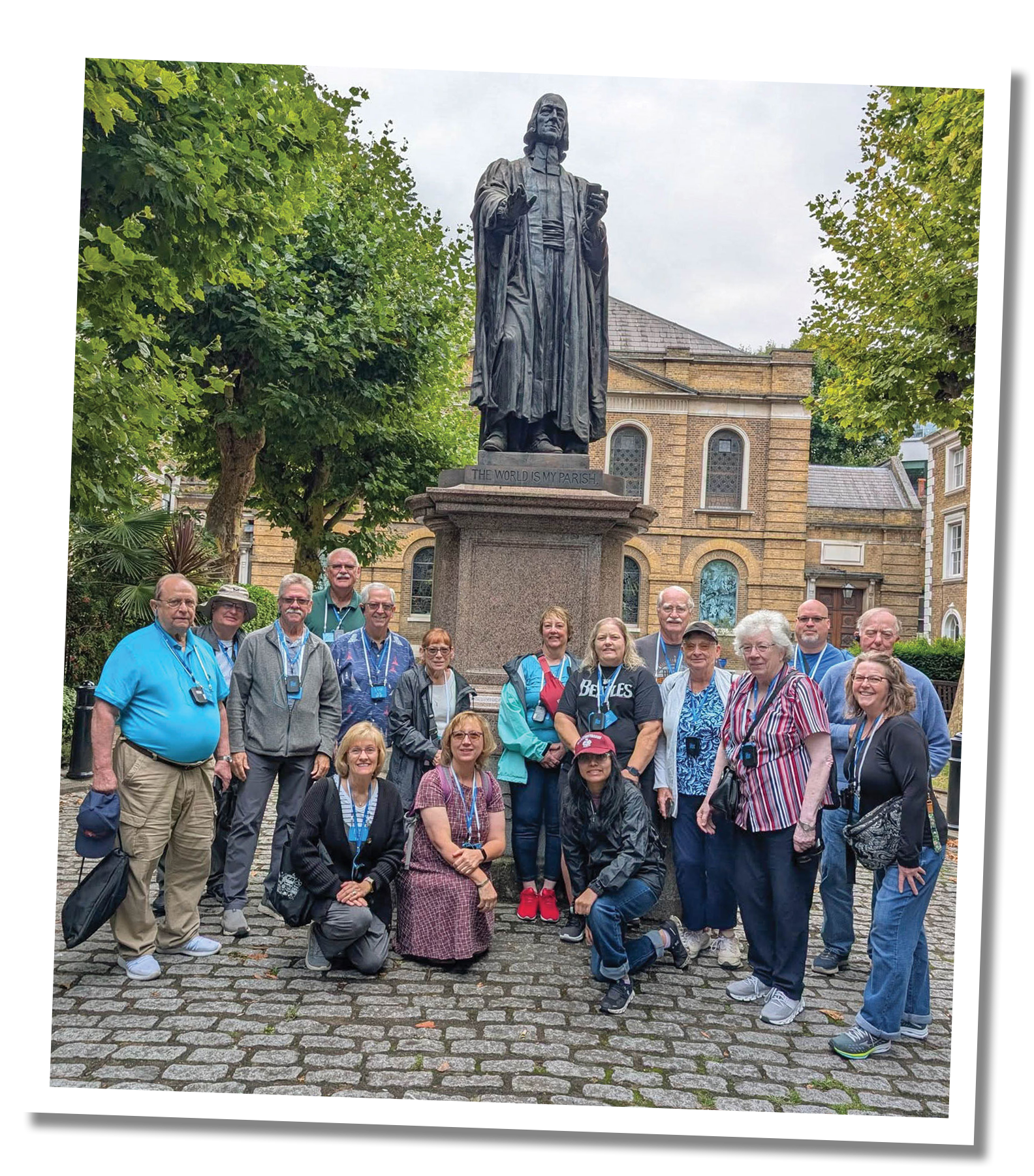
Travelers on an ETS itinerary in front of a statue of John Wesley, the founder of the Methodist denomination of Christianity, at his chapel in London. (Courtesy of ETS Tours)
Travelers on an ETS itinerary in front of a statue of John Wesley, the founder of the Methodist denomination of Christianity, at his chapel in London. (Courtesy of ETS Tours)
While some of these destinations grew as Israel declined, Welch said the market is strong enough for these destinations to thrive even after Holy Land tours resume regular departures.
This was echoed by Globus family of brands chief marketing officer Steve Born, who said that Holy Land tours typically make up 30% of Globus’ religious travel volume, but that Globus and sister brand Cosmos, which both operate faith-based itineraries, has paused them due to the war. And while there is “no substitute” for a Holy Land tour, he said places like Greece, Turkiye and Spain will remain popular for religious travel long after things return to normal in the Middle East. “We expect them to continue to appeal to those seeking a deeper connection,” Born said. “This isn’t a zero-sum landscape. Instead, it reflects a broader trend of travelers seeking out purpose-driven journeys around the world.”
One event that buoyed faith-based travel outside of the Holy Land this year was Italy’s Catholic Jubilee, a tradition celebrated once every 25 years.
Even operators that don’t typically offer religious travel rolled out itineraries dedicated to celebrating the Jubilee due to its significance for the religious and secular alike.
Globus said Jubilee itineraries strengthened religious tourism numbers this year, and travel for the Jubilee buoyed Collette’s faith-based travel numbers, according to chief revenue officer Jeff Roy; the company operated at 90% of its 2019 faith-based travel volume in 2025.
And while Roy said he expects those numbers to come down some in 2026 without Jubilee tours, he isn’t overly worried, thanks to the resiliency of the faith-based market.
“They’re very committed travelers,” he said. “They want to have those experiences no matter what.”
The resiliency of that traveler has given operators the inspiration to tap into new destinations.
Like ETS, Collette also observed growth in Greece for religious travel, along with France and Portugal. France is quite popular, Roy said, especially the Sanctuary of Our Lady of Lourdes, among Catholicism’s most popular pilgrimage sites.
Roy said he thinks Ireland poses an opportunity for the operator to explore, especially for Catholic travelers. He also hopes to reintroduce a Poland pilgrimage that was axed due to the Russia-Ukraine war.

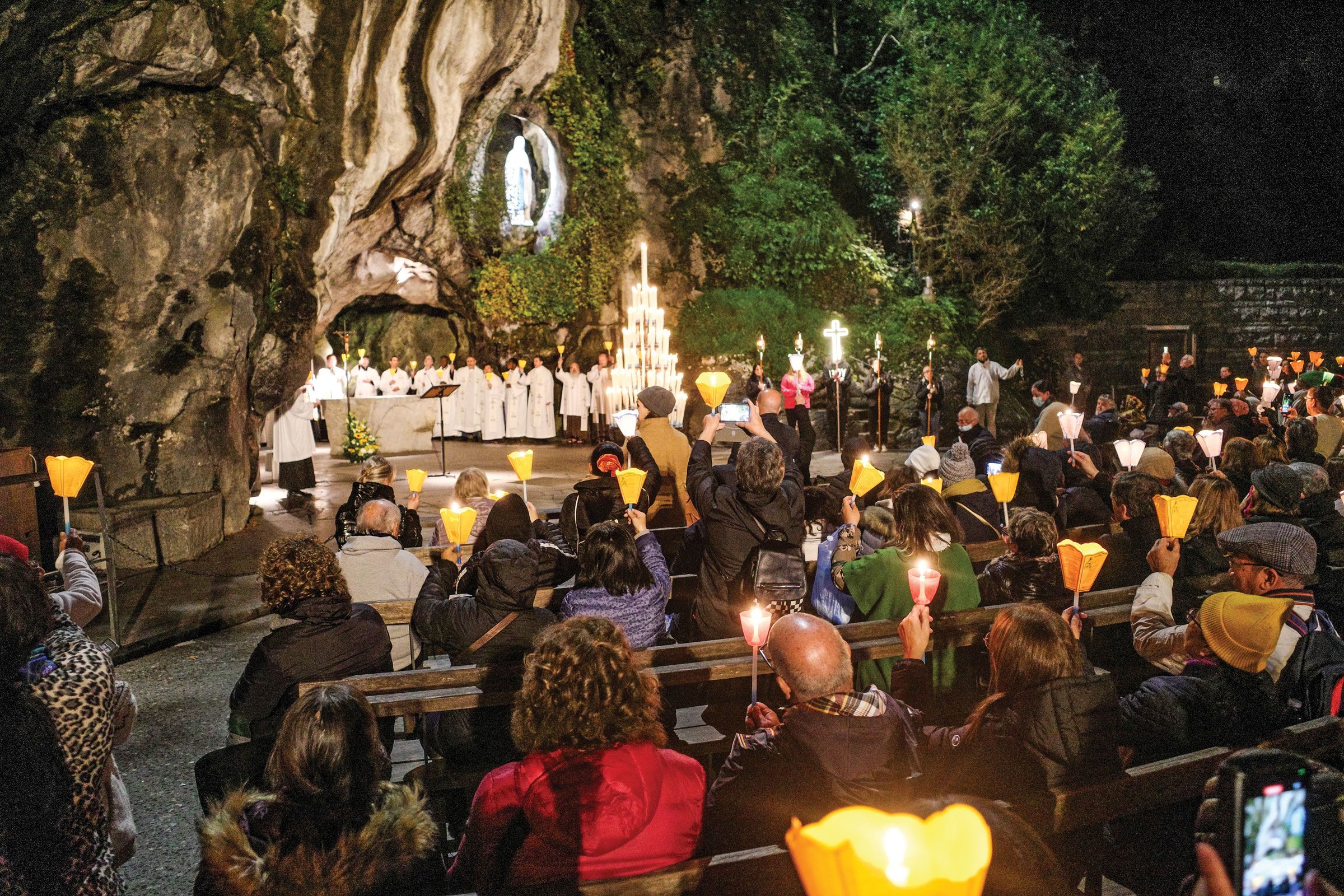
Pilgrims attend a Mass at the Our Lady of Lourdes statue in Massabielle, France. (Photo by Mark Green/Shutterstock)
Pilgrims attend a Mass at the Our Lady of Lourdes statue in Massabielle, France. (Photo by Mark Green/Shutterstock)
Pilgrimages gain popularity
Pilgrimages, one of the earliest types of travel, is another trend operators have seen in recent years. Typically, one thinks of the Middle East or Italy for such a trip, said ETS’ Welch. But that’s changing.
In addition to Lourdes, Catholic travelers are now making pilgrimages to sites in Mexico, Portugal and Spain, especially people with a Hispanic or Latino background who want to connect more deeply to their culture as well as their faith, he said.
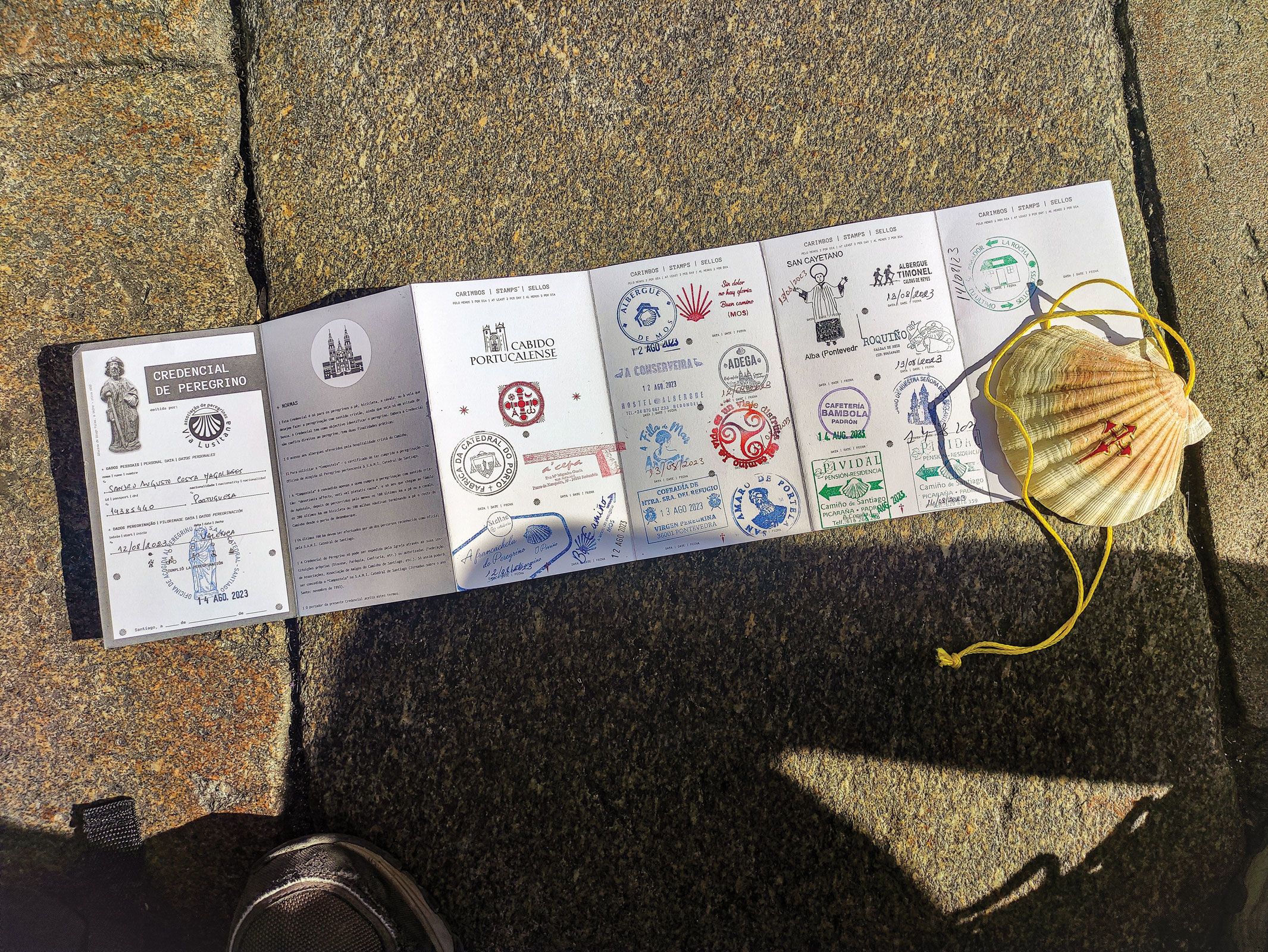
Born said the Camino de Santiago holds potential as a destination for those who want to deeply immerse themselves in a religious site. Mostly in Spain, Globus offers a Camino de Santiago tour focused on the Portuguese side of the trail, traveling roundtrip from Porto. Guests walk about 75 miles of the route under the watchful eye of a guide, Born said, on an itinerary designed for those who want to experience a pilgrimage but also crave the “bells and whistles” of a guided tour.
Perillo Tours also reported strong interest in the Camino, typically sending five or six groups there each spring. The Italy specialist began observing a surge in faith-based travel coming out of the Covid pandemic, said owner and president Steve Perillo, who wants to grow the segment into “quite a serious business. I personally decided to get into it, because we’re such a strong Italy company, so we’re a natural fit.”
Most of the faith-based itineraries come from the company’s custom travel business, with church groups and organizations seeking bespoke trips to explore their faith. Typically, these are older clients embarking on a bucket-list trip, Perillo said.
Like other operators, he’s seen increased interest in Greece and Turkiye, which he said are especially powerful countries to explore through a religious lens. They “really take you back to the first century when the Apostles were traveling around Europe and Turkiye,” Perillo said.
‘Faith-based travelers are
very committed. They want to have those experiences no matter what.’
Though Turkiye’s tourism board does not track faith-based travel visitation numbers, it said it has observed more Americans visiting the country than ever before, with growing demand for cities with strong ties to Christianity, like Edirne and Izmir. “Turkiye places great importance on faith tourism,” the tourism board said, and markets itself as “a cradle of faith,” with a website dedicated to faith-based tourism, including Islam. (Though the faith-based travel market includes all religions, offerings for Christians and Catholics dominate the North American market.)
Israel’s neighboring countries that are frequently tacked onto Holy Land trips have also suffered due to the war.
Jordan, for example, has seen its tourism plummet anywhere between an estimated 70% and 90% since the conflict began, and is likely to see further setbacks due to the shuttering of its North America tourism board, even as operators acknowledge the important religious history there. Petra, for example, is believed to be the site where Moses struck a rock to produce water and where his brother Aaron is buried. However, Welch said, Jordan’s success and failures in tourism have always been tied to Israel.
Travel to Egypt for ETS, meanwhile, is on the upswing but not performing quite at its full potential for the operator, even as the country’s tourism is projected to break records this year. Welch credited Egypt with marketing itself “exceptionally well” amid the conflict and said while the country accounts for less than 10% of ETS’ business, he thinks that could grow in the coming months.




What the future holds for Israel
For a small country, Israel has long enjoyed a strong tourism sector. It has promoted other niches besides faith-based tourism — culinary travel, for example; but according to data from 2018, the last time its tourism ministry kept track, the majority of its visitors identified as Christian, many eager to see the places where they believe stories from the Bible unfolded.
But the Israel-Hamas war, now the longest in Israel’s history, has effectively stalled tourism to the country: less than a million people visited in 2024, far below the record 4.5 million in 2019.
The country and travel suppliers hope the ceasefire will restore traveler confidence, something airlines seem to be banking on. Delta Air Lines resumed service from New York to Tel Aviv Sept. 1 and plans to resume Israel service from Boston and Atlanta in the spring. American Airlines will resume daily New York JFK-Tel Aviv flights on March 31, which the airline hasn’t flown since the war began. United now flies from Newark, Chicago O’Hare and Washington Dulles to Tel Aviv.
While quite a few Israel specialists are operating tours in the country, many of the larger tour companies have yet to come back. Tauck plans to resume operations in Israel next October, with the single departure for its small group Israel and Jordan itinerary sold out, highlighting the demand. Collette hasn’t yet solidified a return to Israel; the same goes for Globus. But operators said there is pent-up demand for the region, and they expect a travel boom when they can return.
“Israel has long been a meaningful and resilient destination for travelers, and we believe it will continue to be — when the time is right,” said Globus’ Born. “As safety and security conditions stabilize and traveler confidence returns, those who cherish the destination will be interested in the experience again.”
Israel’s tourism ministry, meanwhile, remains hopeful that 2026 will be the year tourism turns a corner.
“Israel will enter spring with renewed vitality, strengthened by the current ceasefire, the restoration of key flight routes and a lineup of meaningful cultural events,” said Yoram Elgrabli, the North America tourism commissioner for the Israel Ministry of Tourism.